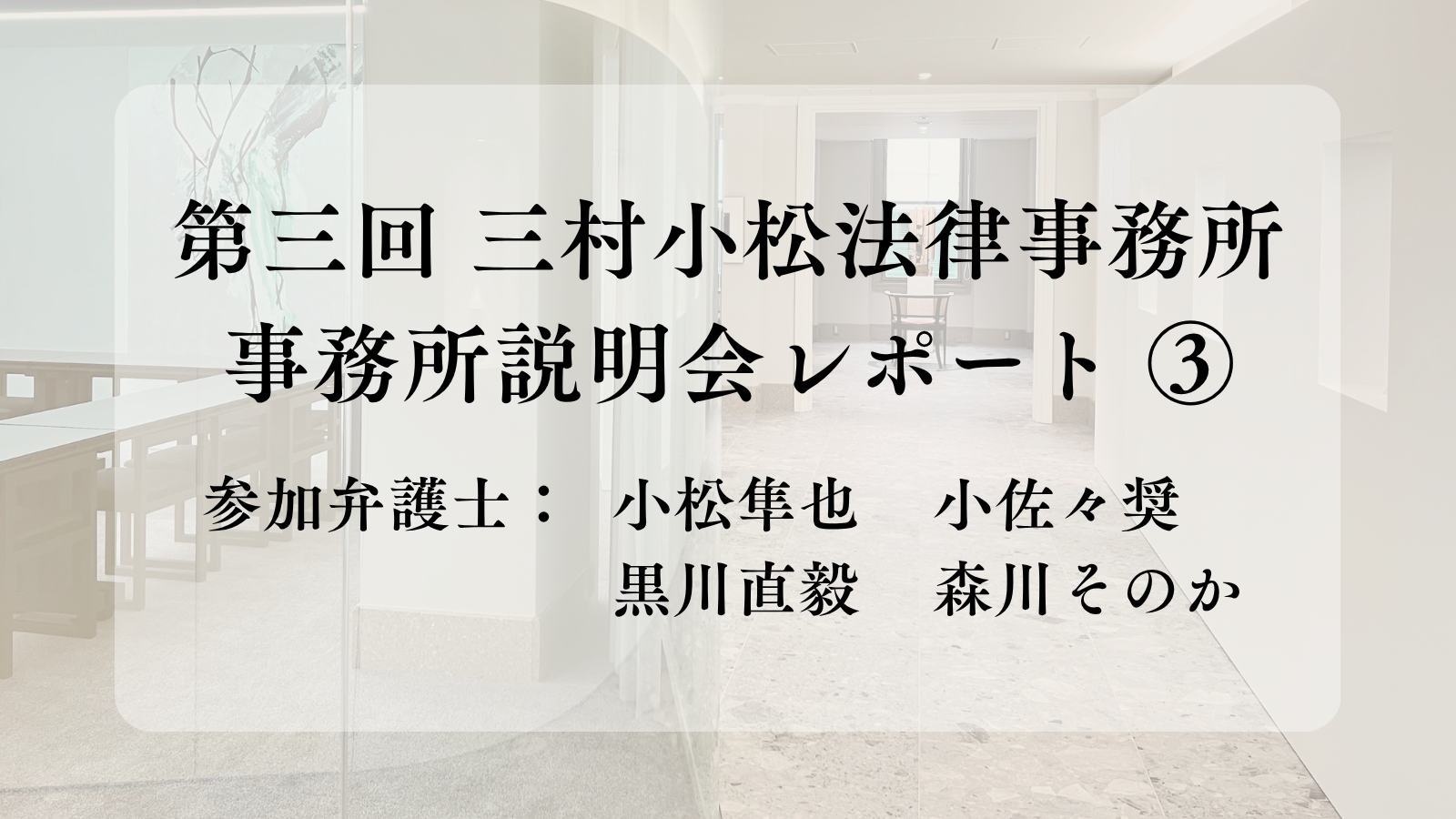
[Third Office Information Session Report ③]
Information Session Q&A: Secondment, New Graduate Recruitment, and Future Focus Areas


Mimura Komatsu Law Office was established in 2019 by lawyers Ryoichi Mimura and Junya Komatsu. Initially, it started as a small firm with only a few lawyers, but it has expanded its business focusing on intellectual property, dispute resolution, and corporate law, and as of September 2026, it has grown to a team of 31 lawyers, including 9 former judges.
On September 15, 2026, Mimura Komatsu Law Office held its third firm information session, which was attended by approximately 50 lawyers, legal apprentices, and law school students, both in person and online. The program included an introduction to the firm's history and areas of practice, a panel discussion, a Q&A session, and a social gathering, fostering a lively exchange of opinions.
This article, based on answers to questions received during the Q&A session, will provide insights into working at our firm through practical, specific details such as the growth environment, the attitude we expect from new lawyers, our approach to career development, working hours and compensation guidelines, and our training system.
Please see the article below for information on the firm's history, areas of practice, and characteristics.
Click here for a list of reports from the office information sessions.
—Even if a ministry has no prior partnership history with one, will they still support a secondment placement that the individual has found?
(I.e.
Rather, we encourage our employees to find their own assignments and, if the opportunity arises, to take on the challenge. We would almost never refuse, and it would be a great help to the office if you could find an assignment for us. If there is an assignment you would like to go to and the office has connections, we will support you in making that possible.
Morikawa
Since we're all working on this together, if you consult with us as early as possible, we'll move towards adjustment rather than opposition. Ms. Komatsu seems to have the image of encouraging even quite unreasonable requests.The agency's basic stance is to "move in a direction that pioneers new paths."I think it 's.
—What do you look for in a newly graduated lawyer with no prior work experience?
(I.e.
What we ask of new graduate lawyers is "not to be too picky." If they have a distinctive background from their previous job, we may encourage them to showcase their expertise early on, but for new graduates with no prior work experience, we want them to first gain experience in various fields. We want them to build a foundation of negotiation experience, including general civil cases, and the ability to think for themselves, before developing their desired area of specialization.
Kurokawa
The work methods and sensibilities you acquire in the first one or two years are hard to shake off later on. That's why, if you can gain diverse experience in our firm's style during that crucial period, we believe that in five or ten years, you will become an extremely reliable member of our team.
──What will be the ratio of new graduate hires to mid-career hires in the future?
(I.e.
We plan to continue hiring new graduates every year, depending on the size of the office. We will also continue hiring experienced professionals. Currently, the proportion of experienced hires is high, with only a few out of approximately 30 employees being genuine new graduates. This is because we only started seriously hiring new graduates in 2024.
We don't have a strong preference for a specific ratio. However, due to the large number of cases we had on hand, we haven't been able to fully establish a system to accept new graduates until now. As the firm's structure has become more ideal, the proportion of new graduates may increase in the future. That being said, we are not stopping hiring experienced professionals, and we will continue to keep our doors open to lawyers who are a good fit for new or related fields.
Kosasa
Regarding the size of the firm, I believe that if we increase too much from our current size of around 30 people, we will lose the advantage of "being able to see each other's faces." Of course, if the number of clients and cases increases in the future, the number of lawyers will naturally increase as well, but I don't think we will rapidly expand to a size of 100 people. We are mindful of maintaining a size that allows us to be easily accessible to our clients.
—Is the policy of "emphasizing the industrial sector" a shift in direction from a litigation firm?
(I.e.
No, this is not a change of direction. We have been emphasizing the industrial sector since our founding, and we have consistently promoted "strong in litigation," "intellectual property," and "industrial sector" simultaneously. While we may have a strong image as an intellectual property firm, we also handle a large number of lawsuits unrelated to intellectual property.
More precisely, it's a "general corporate law firm with a focus on specific industries," meaning it's closer to comprehensive corporate legal services. Looking at the firm as a whole, we handle a remarkably wide range of cases, from family law and personal bankruptcy to damages, traffic accidents, general civil cases, and criminal cases. Each lawyer has their own area of expertise, but they also take on diverse cases according to their preferences. I think the image of "we handle a wider variety of fields than you might think" is more accurate.
—Are there any industries you'd like to focus on in the future?
(I.e.
Personally, I'm interested in and working in the global food industry. The number of cases is actually increasing, and I feel there's a great demand. For example, sushi chefs and Michelin-starred chefs are expanding overseas, or overseas chefs are expanding into Japan. In such situations, there's a real shortage of lawyers they can consult.
When consulting on overseas expansion, we encounter issues very similar to those we normally handle, such as whether to establish a subsidiary overseas, form a joint venture, how to secure financing, local hiring, rentals, and visa issues. Upon investigation, we discovered that there is a broad field overseas called "hospitality law," which includes everything from hotel securitization, and overseas expansion is positioned as a part of it. Leveraging our connections with my previous firm, interested lawyers within our firm are gathering to conduct research, interviews, and surveys as preparations. However, we don't want to take too much time to expand the business, as a sudden influx of cases would overwhelm us.
Mimura Komatsu Law Office is looking for new team members.
Mimura and Komatsu Law Office's philosophy is to "provide solutions that go one step beyond what our clients are looking for," and our team of lawyers with experience as judges and lawyers who are well versed in industry practices and global knowledge aims to provide practical services quickly.
We are seeking motivated lawyers, both new graduates and experienced professionals, who share our firm's philosophy and goals, possess a constant spirit of challenge, and wish to utilize their interest in various industries and fields, as well as their past experience.
For details and application requirements, please see below.CLICK HERE
Profiles of the Participating Lawyers
KOMATSU Junya(Komatsu Junya)
Co-Managing Partner of Mimura Komatsu Law Offices. After handling numerous large-scale disputes and global cases in the litigation team at Nagashima Ohno & Tsunematsu Law Offices, he co-founded this firm with lawyer Ryoichi Mimura in 2019. He studied fashion law, art law, and entertainment law through his studies at a US law school. He provides specialized legal services in Japan for various industrial sectors. While focusing on intellectual property, he also handles a wide range of fields including copyright, art, entertainment, and architecture. His philosophy is to "propose solutions that go one step beyond what clients are looking for."
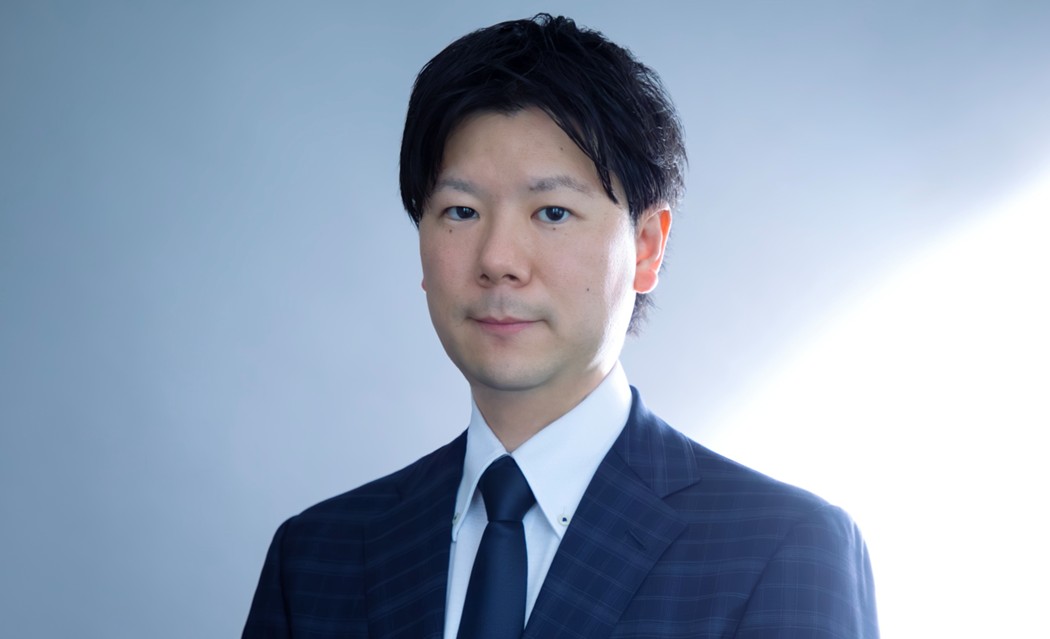
KOSASA Sho(Kosasa Sho)
After working at Hironaka Law Office, he joined Mimura Komatsu Law Office. In his previous position, he handled large-scale international criminal cases, as well as civil litigation, which constituted the majority of cases, dealing with a wide range of issues from defamation and entertainment to family law. He also gained practical experience in corporate law through secondment to a business company. In recent years, he has focused on crisis management and misconduct response, serving as a member of third-party committees for listed companies. While he has a strong track record in responding to emergencies that occur within companies, he also continues to work on diverse cases, including patent litigation involving intellectual property.
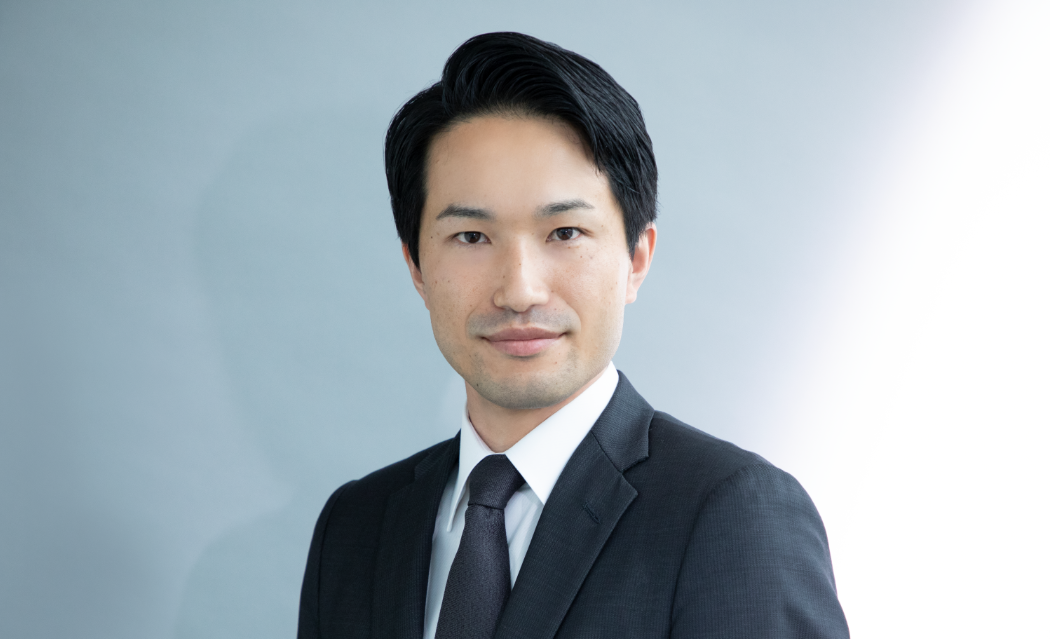
Naoki Kurokawa(Naoki Kurokawa)
He is well-versed in the Unfair Competition Prevention Act and the practical aspects of trade secrets. After working at a firm primarily focused on franchises and a general firm handling patent litigation, he was seconded to the Intellectual Property Policy Office of the Ministry of Economy, Trade and Industry for four years. During his secondment, he was involved in the 2023 amendment to the Unfair Competition Prevention Act, and was not only involved in the revision of the trade secret management guidelines and the establishment of a research group on "protection of voice," but also gave lectures at overseas symposiums and universities. Currently, he also serves as an investigator for the Civil Affairs Bureau of the Ministry of Justice and is also focusing on various seminars. While handling consultations on trade secrets and litigation involving trade secrets, unfair competition laws, patents, and copyrights, he is expanding his expertise to the entire field of intellectual property.
Morikawa Sonoka(Morikawa Sonoka)
A lawyer with extensive practical experience in the entertainment industry, particularly in the music sector. After working at a law firm specializing in startup support, he joined the contracts department of Sony Music Entertainment. There, he handled numerous legal matters close to the production process, including contracts with new artists, master recording rights, and distribution of master recording royalties. Currently, in addition to music, he handles corporate legal affairs for the entire entertainment industry, including performers, film, and dance. His work extends beyond the legal framework of copyright and master recording rights, encompassing general corporate law for the entertainment industry, taking into account industry-specific business practices and market trends.
*The report content and lawyer profile information are current as of the time of writing this article.
【2026.10.5】
Click here for legal advice and media appearances
ContactMiKoTama email magazine
Distributing various legal information topics via email newsletter
Related article
-
[Trade Secrets / Seminar Report - Part 2]
Leaking it is a disaster. Even letting it get in is a disaster. ~The reality and practical aspects of trade secret risk~MIKOTAMA Seminar #09, hosted by Mimura Komatsu Law Office, was held on September 29, 2026...
-
[Trade Secrets / Seminar Report - Part 2]
Leaking it is a disaster. Even letting it get in is a disaster. ~The reality and practical aspects of trade secret risk~MIKOTAMA Seminar #09, hosted by Mimura Komatsu Law Office, was held on September 29, 2026...
-
[Trade Secrets / Seminar Report Part 1]
Leaking it is a disaster. Even letting it get in is a disaster. ~The reality and practical aspects of trade secret risk~MIKOTAMA Seminar #09, hosted by Mimura Komatsu Law Office, was held on September 29, 2026...