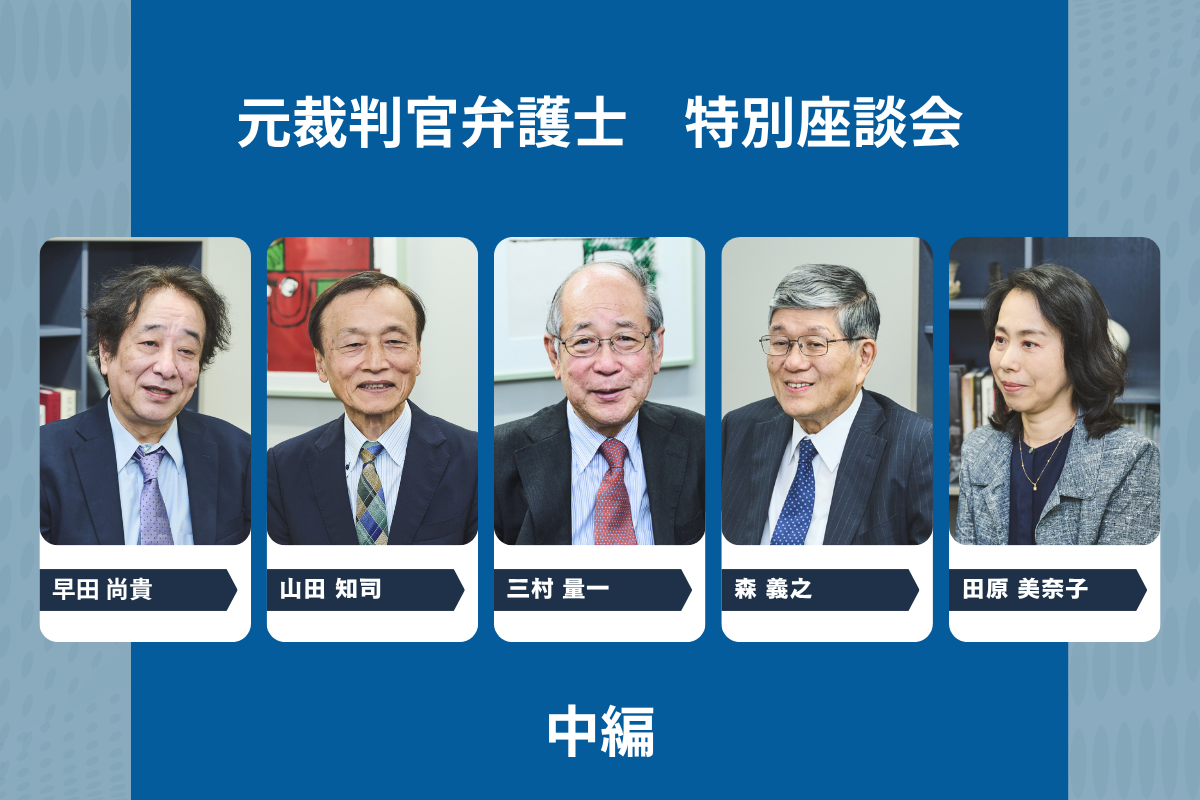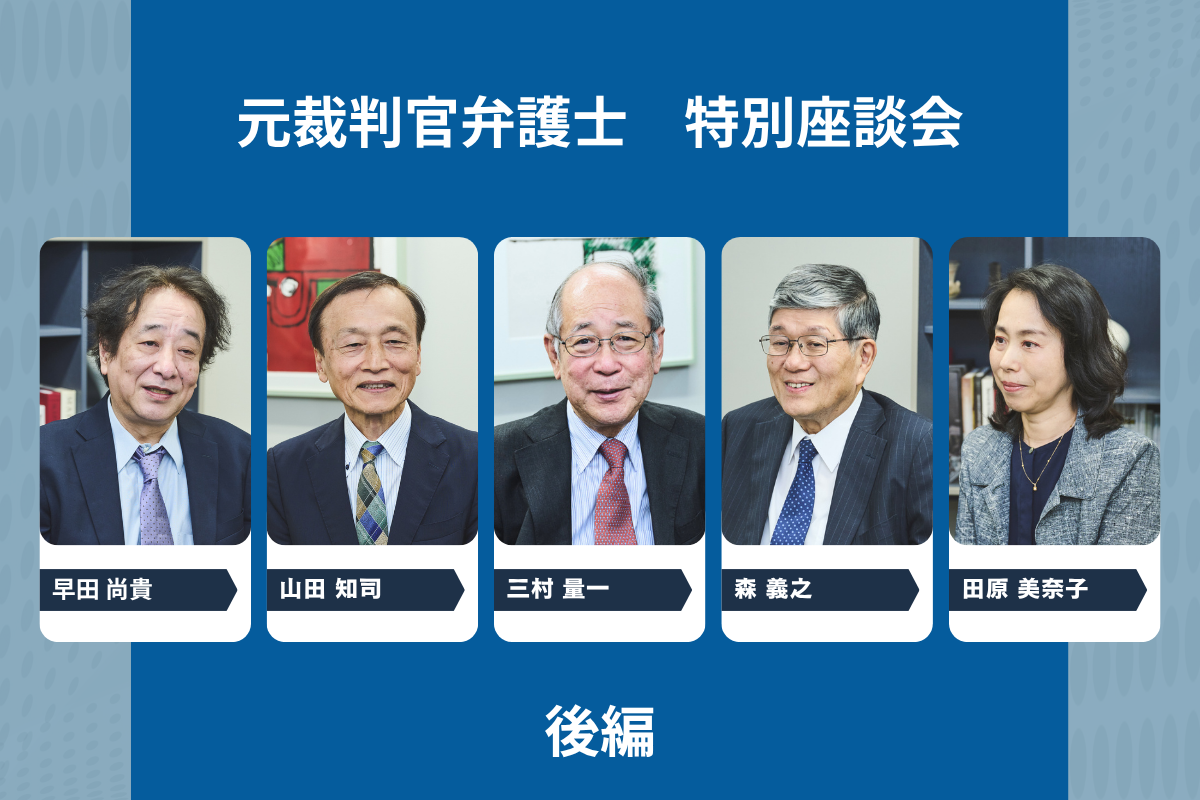
[Special Roundtable Discussion with Former Judges and Lawyers - Part 2]
Five former judges turned lawyers discuss law firms that are "strong in litigation."
—Two perspectives: "Judges" and "Lawyers"


"Can we really win this lawsuit?" — Many corporate legal staff and executives have likely harbored this anxiety at some point. Despite consulting with external lawyers, many companies have experienced unexpected defeats due to the lawyers' overly optimistic assessments.
Mimura Komatsu Law Office has six lawyers who are former judges, including one with experience as a judge in a US court. In this article, experts with experience as both judges and lawyers will share insights into what courts look at when making decisions, and why other law firms seek their opinions, in a roundtable discussion format with the lawyers who support this "litigation-savvy" law firm.
Corporate preparedness for labor disputes
A lawyer's perspective, based on experience in both the Tokyo District Court's Labor Division and large law firms.
—Professor Hayata, you have experience in the labor division of the Tokyo District Court. Could you tell us about the points to be aware of in labor disputes involving companies?.
Hayata
Labor disputes are numerous, and if they escalate, they can take a long time to resolve. On the other hand, in most cases, they don't affect the very core of a company's operations.Taking steps toward settlement at an early stage is often effective for companies.I feel.
In recent years, labor mobility has increased, and side jobs have become more common, but this has also led to an increase in labor-related troubles. In Japan, dismissal is generally difficult, so we expect these disputes to continue to rise. Furthermore, while companies are required to manage working hours not only for part of the work but also for the entire job, it is not realistic to manage employees who have side jobs as well. In addition, with the introduction of so-called job-based systems, disputes often begin with employees who are not producing results, and these new systems can also become a source of conflict if not implemented correctly.
Discrepancies between systems and reality can lead to problems, so it's crucial to implement systems in a way that reflects actual practices, rather than simply setting up the formalities. Surprisingly, not many companies consider this.
Labor disputes are often a field where the outcome depends heavily on factual findings and procedural considerations. Understanding what kind of evidence the court prioritizes and at what stage will make it easier to anticipate the outcome of a dispute. Preparing for disputes in advance, such as having employment regulations and records of working hours, will greatly influence the outcome of future disputes.
—After retiring as a judge, you worked at two law firms, one large and one small. What are some of the major differences or impressions you have of each?
Hayata
After retiring as a judge, I worked at Anderson Mori & Tomotsune Law Office before joining Mimura Komatsu Law Office, and the difference is like that between a large corporation and a small business. In a large firm, as a counsel, my position is basically the same as general sales activities, as I receive work from partner lawyers within the firm. There is no sales activity to acquire clients; I receive fees for providing advice within the firm. The attitude required of a partner and a counsel are vastly different.
Having experienced the different cultures of both a judge and a lawyer, I feel I've gained a balanced perspective that allows me to understand both the client's point of view and the court's.This allows you to have both an insider's perspective on the court system and the perspective of supporting businesses at a large law firm.I believe this is also meaningful for the client.
Key points in corporate disputes concerning administration, taxation, and inheritance.
Court ruling trends and responses to defamation risks for family businesses
—Professor Mori, you have experience in the administrative and tax departments. Corporate disputes involving administrative actions and taxation have different "judicial quirks" compared to intellectual property disputes. What kind of preparations would be effective?
Woods
Judges independently judge cases based on their own responsibility, so their individual styles often come through. The way a particular court makes decisions can vary greatly depending on the judge in charge. Furthermore, specialized divisions focus on specific fields, which can lead to the development of departmental tendencies. For example, judges in specialized divisions such as administration, taxation, and intellectual property tend to share a certain degree of common perspective. However, these tendencies can change as soon as a case is transferred to a different division, making this aspect very difficult to observe from the outside.
The district courts in Tokyo and Osaka have specialized divisions that handle intellectual property cases, and the high courts also hear these cases in the Intellectual Property High Court or the division of the Osaka High Court that handles intellectual property cases. Therefore, the cases are handled by judges from these specialized divisions throughout the first and second instances. However, other types of cases, such as administrative cases, do not have specialized divisions in the high courts.Even for the same case, the way the trial is conducted and the points emphasized can differ depending on whether it's in the district court or the high court, or which division and which judge is in charge..
Tahara
While appellate courts (high courts) tend to respect the decisions of first-instance courts, especially those of specialized departments, some judges are inclined to stick to their own judgments, which can sometimes lead to unexpected outcomes. Understanding these tendencies and preparing a litigation strategy, including how far to pursue the case, is essential for companies.
Woods
In disputes involving government or tax matters, it is crucial for companies to organize their interactions with the government and the documents they have submitted in chronological order, as this will be of great importance in subsequent disputes. Unlike civil cases where you are arguing with an opposing party on equal footing, the government field has a unique structure due to its relationship with regulatory authorities. That is why it is important to have all the necessary documents.
—Mr. Tahara, you have extensive experience, including in family court. Do you have any advice for business owners regarding disputes in owner-managed and family-owned businesses, as well as defamation and compliance investigations?
Tahara
In disputes involving family businesses, a common issue is the question of "who owns the assets and shares of a company?" Many such inheritance-related cases involving small and medium-sized enterprises are brought to local courts. When inheritance is involved, multiple heirs may appoint their own representatives for a single asset, leading to multiple disputes arising from a single case. This results in significant costs and time investment. These disputes tend to escalate to a large scale, especially for those who have built wealth through successful businesses in rural areas.
That's why it's crucial to decide exactly what you're going to do at an earlier stage. I urge you to decide who will take over your shares and business while you're still healthy, and to ensure you have the necessary legal backing.
Yamada
At the root of the problem is,The focus is solely on tax avoidance, and the establishment of legal rights and obligations is being neglected.This is the situation we see. There are many cases where tax accountants focus so much on tax savings that the legal rights become unclear, which then becomes the trigger for disputes. We recommend consulting with a lawyer at an early stage, not only about tax savings but also about the legal implications. This perspective is especially crucial for family businesses. While ventures and startups often start with a certain level of legal framework in place, family businesses where accounting is handled by family members tend to have weaker legal systems.
Tahara
I would also like to comment on investigations related to defamation and compliance. Compliance investigations primarily involve conducting interviews to gather facts and compiling them into investigation reports. I feel that this work is very similar to the work of a judge. In terms of determining the facts based on numerous documents and interviews, organizing the case, and then evaluating and judging it, it is exactly what I have done as a judge.
Depending on the case, internal relationships can be intricately intertwined, and sometimes the party that originally pointed out the problem is instead attacked. That's why,Conducting an impartial investigation from a third-party perspective and documenting the results of the review serves as a form of preparation for companies and individual executives.The risks of defamation and reputational damage have been increasing in recent years, so I think it's necessary to take precautions like this before problems escalate.
Contract and evidence strategies to prevent disputes
Key points of preventative legal measures that medium-sized and small businesses should be aware of
—Can you provide advice from the contract and evidence stage, with a view to potential litigation?
Mimura
There are times when it's necessary to use ambiguous wording in contracts, deliberately leaving room for interpretation. In such cases, you can incorporate the perspective that "writing it this way will be advantageous in future litigation." You may also explain the risks of wording that might be disadvantageous to the other party and then offer them a choice, asking "What do you want to do?"
The fact that multiple former judges review the wording at the initial stage and finalize the policy through deliberation is a unique feature that is rarely seen in other law firms.
Hayata
Contracts are often the cause of lawsuits.In fact, it's very rare for the lawyer who drafted the contract to also act as the legal representative in litigation.Therefore, being involved from the contract stage with litigation in mind is of great significance. In fact, we have seen many disputes that could have been prevented if we had consulted with you at the stage of drafting the contract. Also, it is effective to keep records such as emails for parts that cannot be covered in the contract. Much of the evidence used in court is exchanged via email. It is important to keep in mind the characteristics of the Japanese litigation system.
Unlike the United States, Japan does not have a discovery process, meaning that parties can choose which evidence to submit.This is a relatively unusual characteristic. In overseas discovery processes, all evidence must be disclosed as a general rule, but in Japan, the lawyer representing the client can choose which evidence to submit. Understanding this characteristic and advising clients to keep thorough written records from the outset is one of our advantages. However, if no records are kept, it is impossible to make selections, so preparation is essential.
Mimura
Conversely, having a record of facts favorable to your company beforehand can be a powerful weapon when the time comes. Verbal exchanges often lead to "he said, she said" disputes later on. It's important to keep a record of important agreements and confirmations in text format, such as email, each time. Whether or not you have this habit makes a big difference in how easy it is to prove your case in litigation.We can be involved from the contract stage and even provide advice on how to keep daily records.We believe that our strength lies in our knowledge of the practical aspects of litigation.
—For growing mid-sized and small businesses, disputes can shake the very foundation of their operations. As a former judge, is there anything you would like to say to companies that are not yet in the dispute stage?
Yamada
We have handled numerous projects for large corporations.Large corporations have accumulated cutting-edge knowledge in contract practices and dispute resolution. They can then provide that knowledge tailored to the specific circumstances of small and medium-sized enterprises.This is our strength. We believe we can help small and medium-sized enterprises (SMEs) to develop legal systems that are appropriate for their size and circumstances, while using large corporations as a model.
In many small and medium-sized enterprises (SMEs) and venture startups, legal systems are not yet fully established. This is especially true in family-run businesses, where accounting and other administrative tasks are often handled by family members, leading to ambiguous legal relationships and a higher likelihood of future disputes.
Mimura
If you consult with us before a lawsuit arises, we can assess the situation and advise you on how to avoid disputes in the first place. We have multiple former judges review the wording of contracts from the initial stage to ensure they are not disadvantageous in future litigation. We believe that this kind of preventative involvement is the most valuable aspect for our clients.
Instead of responding after a conflict occurs, prepare in advance.This is what I believe is most important for growing companies to protect their business.
For small and medium-sized enterprises (SMEs), a single dispute can often shake the very foundations of their business. Large corporations have legal departments that systematically manage risks and utilize multiple external lawyers. On the other hand, growing companies must handle both management and risk management with limited personnel. That's why being able to obtain accurate advice at crucial moments can make all the difference in their future success.
We strive to adapt the practical standards we've cultivated for large corporations into a format that small and medium-sized enterprises can easily adopt. Because the situation hasn't yet escalated into a dispute, there are many options available.
Messages from Five Former Judges Turned Lawyers
"We can be of help in these kinds of disputes," say lawyers, highlighting their strengths.
—Finally, based on your respective backgrounds, could you each give a brief message about how you can be of assistance in these types of lawsuits and disputes?.
Mimura
I believe I can best excel in handling unprecedented new issues and challenging disputes that could become leading cases. I am not afraid of new challenges and want to help you with judgment backed by experience. Regarding contracts that could lead to litigation, I can help prevent future disputes by providing insights from the wording stage.
Yamada
In addition to intellectual property litigation, we have diverse experience in corporate litigation, administrative litigation, government representation, and notarization, enabling us to handle disputes across various genres. We leverage the collective wisdom of our experts to address situations where multiple issues are intertwined in a single case.
Woods
As a judge, I have handled a wide range of cases, primarily focusing on intellectual property matters. Based on this experience, I aim to provide advice while deeply understanding my clients' businesses and industries.
Hayata
We can assist you not only with litigation, but also with preventative legal services and system development in the preliminary stages, primarily in labor and general civil matters. We sincerely hope that the next generation of lawyers, including those with a background as judges, will thrive in this environment.
Tahara
Based on my experience in intellectual property litigation as well as many other specialized and general civil and inheritance cases, I believe I can be of assistance not only in intellectual property matters but also in general civil matters including inheritance and family business disputes, as well as compliance investigations.
Click here for the first part
Part 2 is here
Legal Consultation Information
If you are a business owner or legal professional with questions such as, "Can we win this lawsuit?" or "Is this wording in the contract acceptable?", please feel free to contact us for a consultation.
At Mimura Komatsu Law Office, our lawyers, many of whom are former judges, provide insights based on a court's perspective. As a law firm strong in litigation, we offer comprehensive support, from preventative legal measures before disputes arise to actual litigation. We can discuss disputes in diverse fields, including intellectual property, corporate law, administrative law, labor law, and inheritance, with multiple former judges working together to provide multifaceted advice. Determining the likelihood of winning at an early stage helps avoid unnecessary litigation and protect your business resources. Please feel free to contact us for a consultation.
For requests and inquiries, please contact us.CLICK HERE
Profile
Ryoichi Mimura
He graduated from the Faculty of Law, University of Tokyo in 1977. From 1979, he served as an assistant judge at the Tokyo District Court, among other positions. From 1981 to 1983, he studied at the University of Cologne in the Federal Republic of Germany. He has served as a research officer at the Supreme Court, chief judge of the Intellectual Property Division of the Tokyo District Court, judge at the Intellectual Property High Court, and judge at the Tokyo High Court. In 2009, he registered with the First Tokyo Bar Association and became a partner at Nagashima Ohno & Tsunematsu Law Offices. In 2019, he co-founded Mimura Komatsu Law Offices. He has served as a member of the Legislative Council, a director of the Copyright Law Society, and a visiting professor at Waseda University Law School, and in 2018, he received the Intellectual Property Achievement Award (Minister of Economy, Trade and Industry Award). He has experience in drafting civil enforcement rules while at the Civil Affairs Bureau, and is well-versed in civil enforcement law and private international law, with a focus on intellectual property law.
Tomoji Yamada
Graduated from the University of Tokyo Faculty of Law in 1977. Worked at various courts from 1979, and from 1993 to 1997 served as a representative (litigation) for the government at the Litigation Department of the Tokyo Legal Affairs Bureau. Served as a judge in the Intellectual Property Division of the Tokyo High Court, and as presiding judge in the Intellectual Property Division, Corporate Law Division, and Administrative Litigation Division of the Osaka District Court, as well as the Intellectual Property Division of the Osaka High Court. Served as a notary public from 2017 to 2024, and joined Mimura Komatsu Law Offices in August 2024. Possesses extremely broad experience in intellectual property, corporate law, administrative litigation, government representation (litigation), and notarization.
Yoshiyuki Mori
He graduated from the Faculty of Law, University of Tokyo in 1979. From 1981, he served as an assistant judge at the Tokyo District Court, among other positions. From 1986 to 1987, he studied in the UK as an overseas research fellow for assistant judges. He has served as chief judge at the Osaka District Court (Administrative and Tax Division), the Nagoya District Court (Administrative and Intellectual Property Division), and the Tokyo District Court (Intellectual Property Division). He has also served as a research officer for the Supreme Court and as a chief judge at the Intellectual Property High Court. In 2026, he joined Mimura Komatsu Law Offices. As a judge, he has been involved in trials in various fields, including administration, taxation, intellectual property, and transportation, for many years.
Naoki Hayata
Graduated from the University of Tokyo Faculty of Law in 1990. Appointed as a judge in 1993. Served as a judge of the Tokyo District Court, Tokyo High Court, Intellectual Property High Court, and head of the First Division of the Administrative Affairs Bureau of the Supreme Court Secretariat. Conducted overseas research at the New Jersey Superior Court in the United States from 1998 to 1999. Served as Special Counsel at Anderson Mori & Tomotsune Law Office from 2015 to 2023. Joined Mimura Komatsu Law Office in October 2023. Proficient in a wide range of fields including labor law, general civil law, judicial administration (Secretariat), constitutional law, and administrative law.
Minako Tahara
Graduated from the Faculty of Law, University of Tokyo. Appointed as a judge in 1996. Served at the Kyoto District Court, Tokyo District Court (Traffic and Industrial Accident Division), Tokyo Family Court (Estate Division), Chiba District Court (Medical Cases Division, etc.), Osaka District Court (Intellectual Property Division), Tokyo High Court, etc. Worked as a lawyer (in France) from 2002 to 2003. Joined Mimura Komatsu Law Offices in August 2024. Member of the Copyright Law Association, the Japan Industrial Property Law Association, and the Intellectual Property Law Study Group of the First Tokyo Bar Association. Has experience in a wide range of civil law fields, including intellectual property, traffic, medical, inheritance, and compliance.
【2026.8.21】
Click here for legal advice and media appearances
ContactMiKoTama email magazine
Distributing various legal information topics via email newsletter
Related article
-
[Series: Generating AI and Voice Protection] Part 2
Tracking domestic and international developments chronologically – From private self-defense to rule-making"My favorite voice actor is singing a song they've never sung before." "In that person's voice, they're saying something they would never say themselves..."
-
Lawyers specializing in handling scandals: "Emergency physician type" lawyers
The Crossroads of Litigation, Criminal Cases, and Intellectual Property (Part 2)[Interview with lawyer Sho Kosasa] "When a problem arises within our company, we don't know who to consult..."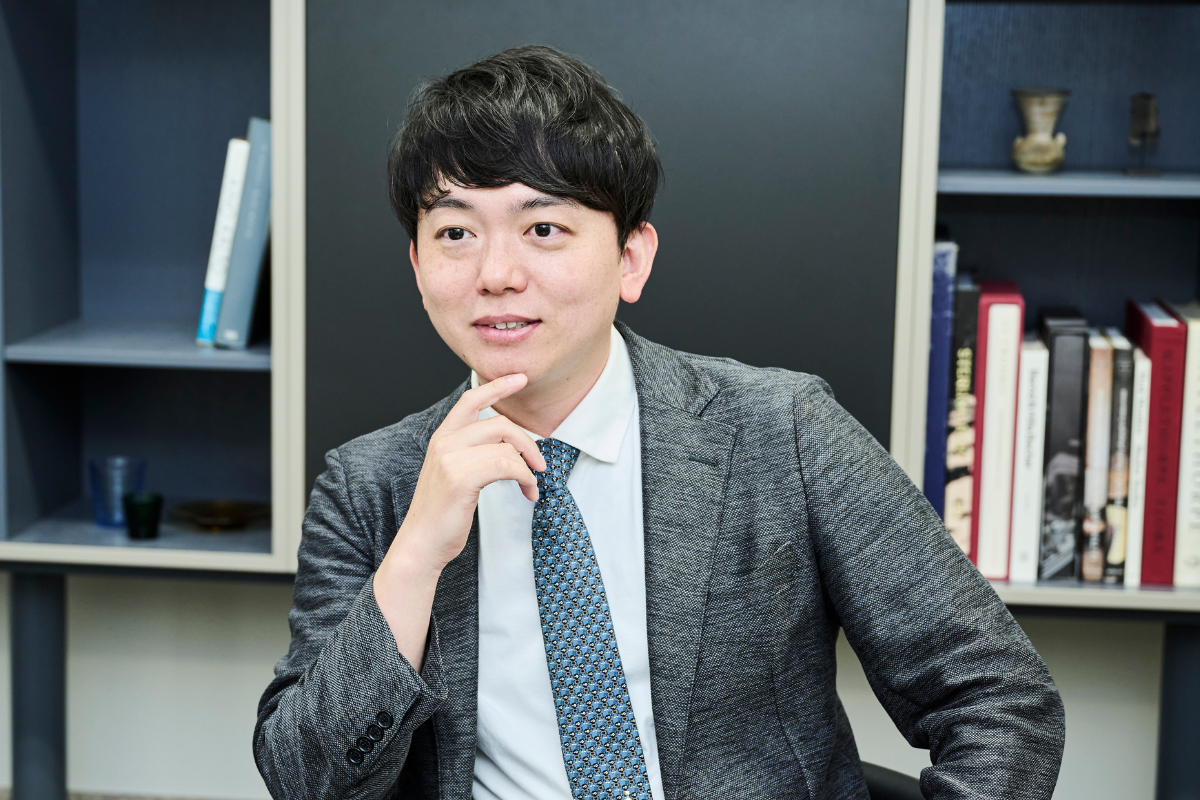
-
[Special Roundtable Discussion with Former Judges and Lawyers - Part 2]
Five former judges turned lawyers discuss law firms that are "strong in litigation."
—Two perspectives: "Judges" and "Lawyers""Can we really win this lawsuit?" — Many corporate legal professionals and executives have thought this at some point...