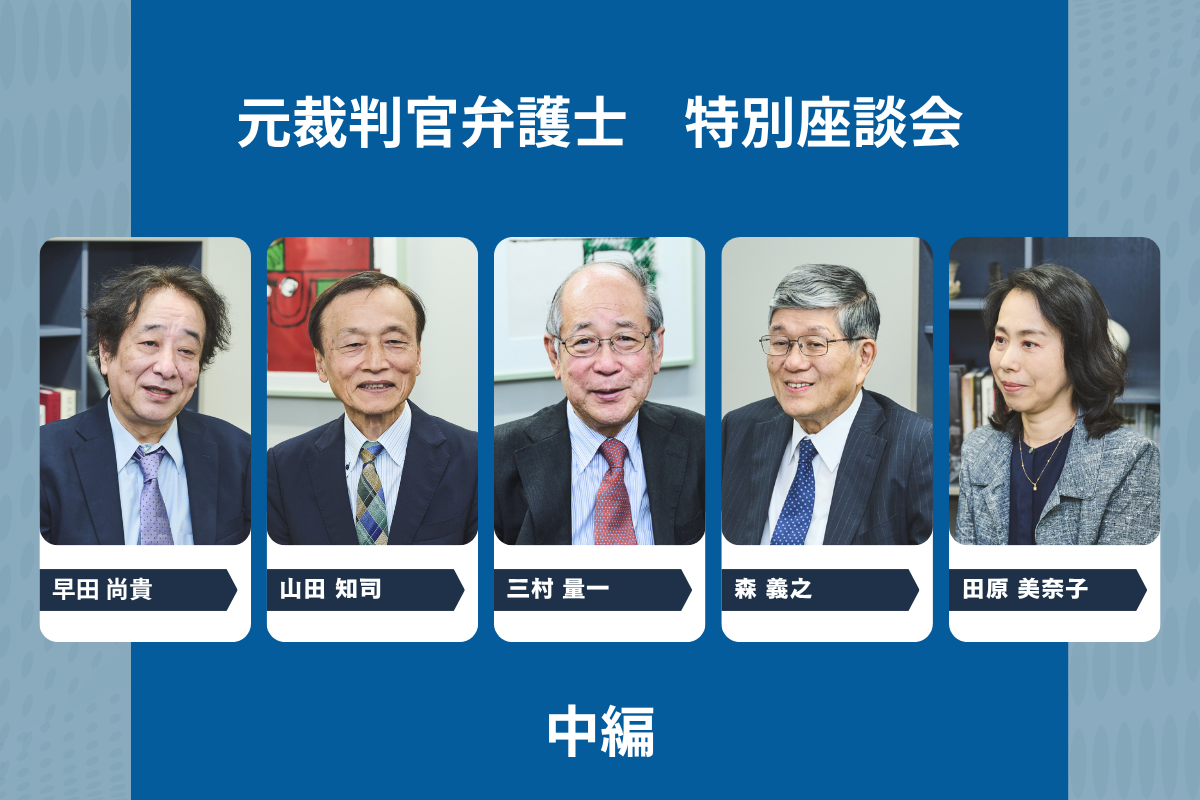
[Special Roundtable Discussion with Former Judges and Lawyers - Part 2]
Five former judges turned lawyers discuss law firms that are "strong in litigation."
—Two perspectives: "Judges" and "Lawyers"


"Can we really win this lawsuit?" — Many corporate legal staff and executives have likely harbored this anxiety at some point. Despite consulting with external lawyers, many companies have experienced unexpected defeats due to the lawyers' overly optimistic assessments.
Mimura Komatsu Law Office has six lawyers who are former judges, including one with experience as a judge in a US court. In this article, experts with experience as both judges and lawyers will share insights into what courts look at when making decisions, and why other law firms seek their opinions, in a roundtable discussion format with the lawyers who support this "litigation-savvy" law firm.
A former judge's perspective that can be applied beyond intellectual property.
The ability to handle procedural matters, evidence, and communication, as well as the ability to respond to unprecedented leading cases.
—What aspects of your experience outside of intellectual property can you apply to advising companies?
Mimura
I feel that there are surprisingly few lawyers who have a deep understanding of civil litigation procedures. They seem to think that it's up to the court to decide, and therefore don't feel the need to know about it themselves.
For the client, this means avoiding the need to proceed with litigation in an odd way or make meaningless claims; moreover,There are advantages such as being able to take effective procedures that ordinary lawyers are unaware of.I think so. In large corporate law firms, the focus is mainly on consultations and contracts, so there are fewer lawyers who handle litigation.
Hayata
Also, Judges have extensive experience in settlement proceedings, making it easier to predict the likelihood of a settlement.There is also.
Even large law firms often simply copy precedent formats when drafting settlement clauses. While there's nothing wrong with that, finding the perfect fit can be time-consuming. Since settlements are contracts, as long as it doesn't ultimately lead to litigation, there's no problem, so they tend to remain as they are.
Tahara
The essence of a judge's job lies in organizing and communicating complex cases in a way that anyone can understand by drafting judgments. This skill is directly applicable to lawyers when explaining matters to clients or presenting arguments to the court. In court, in particular, it is crucial to make reasonable arguments, explain the facts and technical details, and gather the necessary evidence, but it is equally important to organize it in a way that makes it easy for the court to accept.Because I have personally handled trials, I am able to present arguments and evidence in a way that is more likely to be accepted by the court.I think.
Yamada
Furthermore, knowledge of procedural laws such as civil procedure law and civil enforcement is also essential. In fact, surprisingly few lawyers have a deep understanding of these procedural laws. While they may know the general principles found in textbooks, applying them to specific cases requires experience.
Knowing procedural law allows you to offer options such as, "If the other party responds in this way, there might be room to use this procedure."This can prevent the lawsuit from proceeding in an unconventional way, or allow you to gain an advantage by using procedures the opposing party didn't anticipate. This is an idea that is unlikely to come to the average lawyer, and can be a significant benefit to the client. In situations where simply following precedents is insufficient, having a wide range of procedural knowledge comes into play.
Woods
Understanding how to interpret court precedents is crucial. Seemingly unrelated facts can actually influence the outcome of a case.This method of reading court precedents allows you to focus on specific points in the judgment and identify what factors in the case led to the different conclusions.I believe this is a strength unique to someone with experience as a judge who has written judgments. In this way, reading between the lines of a judgment is helpful in considering the next move.
Furthermore, in litigation and negotiations, the way information is communicated, the choice of procedures, and the presentation of facts often determine the outcome more than the legal arguments themselves. I believe that the training I've received as a judge in "clearly organizing and judging" cases across all fields will be valuable when advising companies, regardless of their sector.
—Professor Mimura, you have been involved in many unprecedented leading cases. What are your unique strengths in advising companies?
Mimura
Ultimately, my greatest strength is my ability to foresee the future based on the experience I've accumulated. This was true during my time as a judge, and as a lawyer, I've always been unafraid of new things, proposing new legal interpretations and raising important issues.
Because there is no precedent in the case, we can construct our arguments from the judge's perspective, considering how to make it easier for the court to make a decision. The case concerning copyright royalties in music schools is a typical example of this.In unprecedented legal cases, the key to success lies in anticipating how the court will interpret the issue..
In unprecedented cases, simply applying existing frameworks will not yield answers. It is necessary to consider how this new issue fits within the existing framework, based on the accumulated knowledge of past judgments and the reasoning behind them. It is precisely because of the experience gained from judging numerous cases that judges can chart a course of action even with new legal issues.
We believe that this kind of visionary thinking is a great support when companies face unknown legal risks related to new businesses or new technologies.
As a firm, having several lawyers who are former judges has greatly increased our experience. We believe that having an environment where younger lawyers can easily consult with us on a daily basis when they are unsure about a decision is a major strength. We can convey practical insights such as "You don't need to worry that much" or "Be careful here" through our daily interactions.
Furthermore, with so many experienced former judges gathered together, many of the current judges will also be familiar with them.This makes it easier to make practical assessments regarding interactions with the opposing party and responses to the court's handling of the proceedings.This is a unique strength of Mimura Komatsu Law Office. We believe that this accumulation of experience proves invaluable, especially in unprecedented and challenging disputes.
Going forward, we would like to invite lawyers with a background as judges from the mid-career generation to join us and pass on this experience.
Reasons for being strong in company law, administrative litigation, and contracts
Corporate litigation, disputes with the government and local authorities, and contractual advice based on notary public experience.
—Professor Yamada has experience in corporate law, administrative litigation, and representing the government. Could you tell us about the key points of corporate litigation and the perspectives companies should have when confronting the government, local authorities, or regulations?
Yamada
Company law cases cover a wide range of issues, including shareholders, directors, and M&A.In recent years, disputes surrounding companies, including dealing with activist shareholders, have been increasing, and these types of cases are expected to increase even further in the future.That's my view.
The approach to a case varies greatly depending on whether or not the judge has specialized experience in this field. Based on my experience as the presiding judge of a corporate law case division, the power dynamics between the parties and the legality of the decision-making process tend to be the main points of contention. I recommend consulting with a specialist at an early stage.
Next, let's consider situations involving the national or local government. We sometimes receive inquiries asking, "Should we file an administrative lawsuit?" However, the administrative field is governed by laws, and it's difficult to proceed with litigation unless a clear path to victory is visible within that framework. There are also relationships with supervisory authorities, so it's not something that can be easily dismissed.
Woods
Administrative litigation operates on different principles than civil law. Without understanding these "rules," it's impossible to even begin to assess the situation. Understanding this difference is critically important in determining a winning strategy. Approaching it solely from a civil law perspective can lead to unexpected setbacks.Although both corporate disputes and administrative disputes are categorized under the same word "dispute," they are governed by different rules and regulations.
Yamada
I believe my experience handling numerous administrative lawsuits and state compensation cases as a representative of the government will be of great benefit in this regard.We can advise you from the initial decision of whether to litigate against the national or local government, and whether or not to pursue administrative litigation, while keeping the path to victory in mind.This is where my experience in litigation comes in as a strength. For companies that must comply with regulations, a strategy that takes the regulatory framework itself into account is essential. Because I understand the internal thinking of the government, I can foresee how the other party will act.
Returning to the topic of corporate litigation, disputes concerning shareholders, directors, and M&A are areas where not many lawyers have specialized in. Based on my experience as a presiding judge in the Corporate Law Division, I have seen from the inside what kinds of arguments resonate with the court and where people tend to stumble.
In particular, dealing with activist investors depends heavily on preparations made during peacetime, such as how shareholder meetings are conducted and how information is disclosed. It is important to identify potential points of contention in advance, rather than panicking when a dispute becomes apparent. Because I have experience in both government and corporate departments, I believe I can provide advice that focuses on the "winning strategy" for companies, whether they are confronting the government or resolving internal disputes.
—Mr. Yamada, you also have seven years of experience as a notary public. What is the most important point that parties should pay attention to when entering into a contract?
Yamada
Based on my experience as a notary public, having reviewed numerous contracts, wills, and articles of incorporation, I can say that there are often areas that are likely to cause disputes later on, and these can become apparent during the contracting stage.
Having seen countless contracts that have led to disputes over the years, I know where the seeds of trouble lie. In those areas, I would tell both parties, "Please clarify this point," and prevent them from proceeding with ambiguity. Even the way something is written in Japanese can lead to differing interpretations and disputes.
Avoid ambiguous wording and use clear and unambiguous expressions to prevent misunderstandings.This is the most important point in preventing future disputes. Regarding wills, I have also provided advice on how to write them in a way that prevents future conflicts.
However, it's not impossible to choose to leave things ambiguous. Trying to clarify the details can sometimes make negotiations fail. If the other party insists on specific conditions and negotiations break down, it might be better to conclude the contract while leaving things ambiguous. If the probability of a problem actually occurring is low, it might be better to proceed without finalizing the details.
The important thing is that the parties involved make their own decisions, understanding the risks involved. There's a huge difference between accidentally being vague and being vague while knowing the risks. I believe that being able to advise after discerning the situation to that extent is a strength of my experience as a notary public.
During the contracting phase, the parties tend to focus solely on reaching an immediate agreement. However, contracts are documents that are rarely reread when things are going well. They only truly come into play when the relationship between the parties sours. At that point, if the wording is ambiguous, new disputes will arise over its interpretation.
As a notary public, I have seen many cases that have resulted in disputes in this manner. That is why I recommend pointing out areas that are likely to cause problems later on during the contract stage and clarifying them in a way that is acceptable to both parties. In particular, the method of calculating the amount, the duration, the conditions for termination, and the scope of liability are areas that tend to remain ambiguous. For specific decisions, I recommend consulting with a specialist.
In the second part of this series, we will continue our discussions with five former judges who have also become lawyers, focusing on how companies prepare for disputes, the tendencies of court rulings, and how to deal with various risks.
Click here for the first part
Legal Consultation Information
If you are a business owner or legal professional with questions such as, "Can we win this lawsuit?" or "Is this wording in the contract acceptable?", please feel free to contact us for a consultation.
At Mimura Komatsu Law Office, our lawyers, many of whom are former judges, provide insights based on a court's perspective. As a law firm strong in litigation, we offer comprehensive support, from preventative legal measures before disputes arise to actual litigation. We can discuss disputes in diverse fields, including intellectual property, corporate law, administrative law, labor law, and inheritance, with multiple former judges working together to provide multifaceted advice. Determining the likelihood of winning at an early stage helps avoid unnecessary litigation and protect your business resources. Please feel free to contact us for a consultation.
For requests and inquiries, please contact us.CLICK HERE
Profile
MIMURA Ryoichi(Ryoichi Mimura)
He graduated from the Faculty of Law, University of Tokyo in 1977. From 1979, he served as an assistant judge at the Tokyo District Court, among other positions. From 1981 to 1983, he studied at the University of Cologne in the Federal Republic of Germany. He has served as a research officer at the Supreme Court, chief judge of the Intellectual Property Division of the Tokyo District Court, judge at the Intellectual Property High Court, and judge at the Tokyo High Court. In 2009, he registered with the First Tokyo Bar Association and became a partner at Nagashima Ohno & Tsunematsu Law Offices. In 2019, he co-founded Mimura Komatsu Law Offices. He has served as a member of the Legislative Council, a director of the Copyright Law Society, and a visiting professor at Waseda University Law School, and in 2018, he received the Intellectual Property Achievement Award (Minister of Economy, Trade and Industry Award). He has experience in drafting civil enforcement rules while at the Civil Affairs Bureau, and is well-versed in civil enforcement law and private international law, with a focus on intellectual property law.
Tomoji Yamada(Yamada Tomoji)
Graduated from the University of Tokyo Faculty of Law in 1977. Worked at various courts from 1979, and from 1993 to 1997 served as a representative (litigation) for the government at the Litigation Department of the Tokyo Legal Affairs Bureau. Served as a judge in the Intellectual Property Division of the Tokyo High Court, and as presiding judge in the Intellectual Property Division, Corporate Law Division, and Administrative Litigation Division of the Osaka District Court, as well as the Intellectual Property Division of the Osaka High Court. Served as a notary public from 2017 to 2024, and joined Mimura Komatsu Law Offices in August 2024. Possesses extremely broad experience in intellectual property, corporate law, administrative litigation, government representation (litigation), and notarization.
Yoshiyuki Mori(Yoshiyuki Mori)
He graduated from the Faculty of Law, University of Tokyo in 1979. From 1981, he served as an assistant judge at the Tokyo District Court, among other positions. From 1986 to 1987, he studied in the UK as an overseas research fellow for assistant judges. He has served as chief judge at the Osaka District Court (Administrative and Tax Division), the Nagoya District Court (Administrative and Intellectual Property Division), and the Tokyo District Court (Intellectual Property Division). He has also served as a research officer for the Supreme Court and as a chief judge at the Intellectual Property High Court. In 2026, he joined Mimura Komatsu Law Offices. As a judge, he has been involved in trials in various fields, including administration, taxation, intellectual property, and transportation, for many years.
HAYATA Naoki(Naoki Hayata)
Graduated from the University of Tokyo Faculty of Law in 1990. Appointed as a judge in 1993. Served as a judge of the Tokyo District Court, Tokyo High Court, Intellectual Property High Court, and head of the First Division of the Administrative Affairs Bureau of the Supreme Court Secretariat. Conducted overseas research at the New Jersey Superior Court in the United States from 1998 to 1999. Served as Special Counsel at Anderson Mori & Tomotsune Law Office from 2015 to 2023. Joined Mimura Komatsu Law Office in October 2023. Proficient in a wide range of fields including labor law, general civil law, judicial administration (Secretariat), constitutional law, and administrative law.
Minako Tahara(Tahara Minako)
Graduated from the Faculty of Law, University of Tokyo. Appointed as a judge in 1996. Served at the Kyoto District Court, Tokyo District Court (Traffic and Industrial Accident Division), Tokyo Family Court (Estate Division), Chiba District Court (Medical Cases Division, etc.), Osaka District Court (Intellectual Property Division), Tokyo High Court, etc. Worked as a lawyer (in France) from 2002 to 2003. Joined Mimura Komatsu Law Offices in August 2024. Member of the Copyright Law Association, the Japan Industrial Property Law Association, and the Intellectual Property Law Study Group of the First Tokyo Bar Association. Has experience in a wide range of civil law fields, including intellectual property, traffic, medical, inheritance, and compliance.
【2026.8.10】
Click here for legal advice and media appearances
ContactMiKoTama email magazine
Distributing various legal information topics via email newsletter
Related article
-
[Special Roundtable Discussion with Former Judges and Lawyers - Part 2]
Five former judges turned lawyers discuss law firms that are "strong in litigation."
—Two perspectives: "Judges" and "Lawyers""Can we really win this lawsuit?" — Many corporate legal professionals and executives have thought this at some point...
-
[Series: Generating AI and Voice Protection] Part 2
Tracking domestic and international developments chronologically – From private self-defense to rule-making"My favorite voice actor is singing a song they've never sung before." "In that person's voice, they're saying something they would never say themselves..."
-
Lawyers specializing in handling scandals: "Emergency physician type" lawyers
The Crossroads of Litigation, Criminal Cases, and Intellectual Property (Part 2)[Interview with lawyer Sho Kosasa] "When a problem arises within our company, we don't know who to consult..."