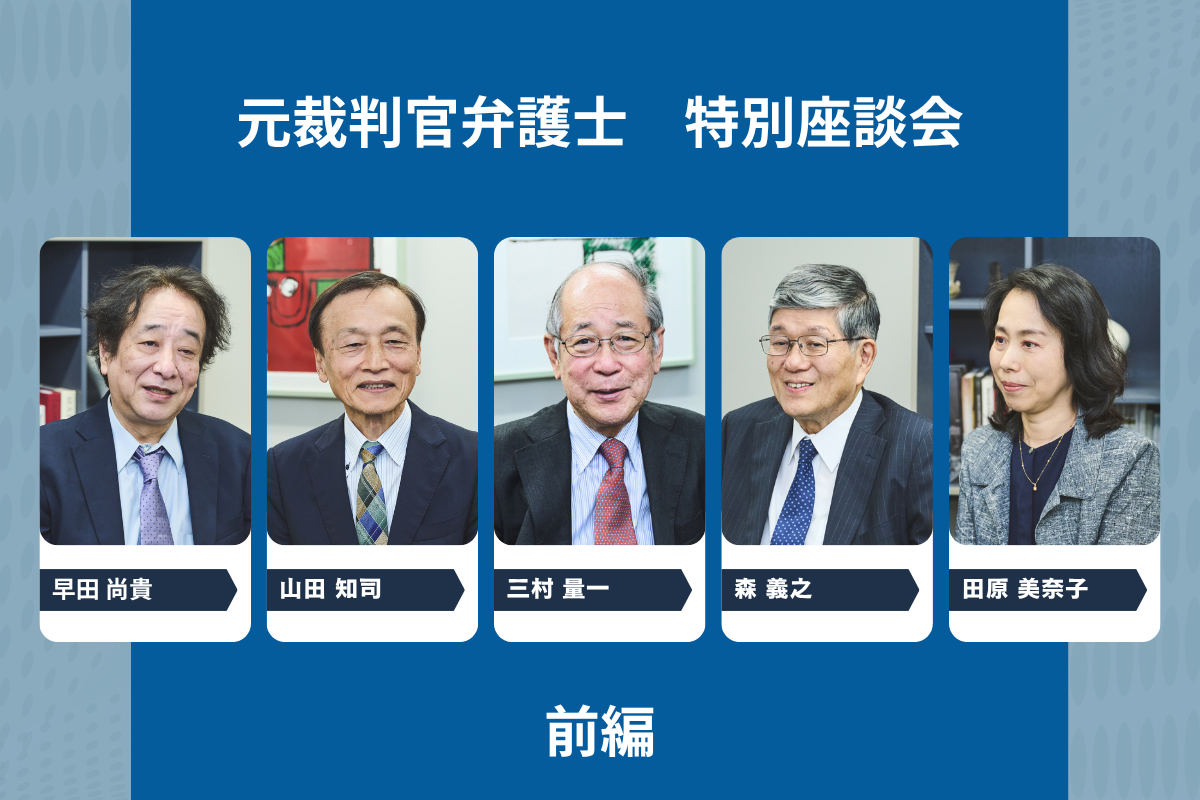
[Special Roundtable Discussion with Former Judges and Lawyers - Part 1]
Five former judges turned lawyers discuss law firms that are "strong in litigation."
—Two perspectives: "Judges" and "Lawyers"


"Can we really win this lawsuit?" — Many corporate legal staff and executives have likely harbored this anxiety at some point. Despite consulting with external lawyers, many companies have experienced unexpected defeats due to the lawyers' overly optimistic assessments.
Mimura Komatsu Law Office has six lawyers who are former judges, including one with experience as a judge in a US court. In this article, experts with experience as both judges and lawyers will share insights into what courts look at when making decisions, and why other law firms seek their opinions, in a roundtable discussion format with the lawyers who support this "litigation-savvy" law firm.
What is Mimura Komatsu Law Office, where lawyers who are former judges gather?
The backgrounds of five former judges and the value of consulting a law firm with multiple former judges on staff.
—First, as a way of introducing yourself, could you tell us about the field you have been involved in the longest as a judge, and the field you are focusing on as a lawyer?
Mimura
I served as a judge for about 30 years, primarily in intellectual property litigation. My total experience in intellectual property litigation is 17 years, including 5 years as a research officer at the Supreme Court (a position deeply involved in the formation of Supreme Court judgments), 2 years as an associate judge and 7 years as presiding judge in the Intellectual Property Division of the Tokyo District Court, and 3 years at the Intellectual Property High Court after its establishment. Judges who have been involved in intellectual property litigation for this long are extremely rare.
Many of the cases I've handled have been well-known trials. For example,He also presided over the first instance judgment in the blue light-emitting diode employee invention lawsuit.I did. Also, during my time as a junior judge, I spent two years in the Civil Affairs Bureau of the Supreme Court, which was shortly after the Civil Execution Act was enacted. I was in charge of drafting related Supreme Court rules. The Civil Execution Act is a law that is always applied in the final stages of a case, such as "what happens if the other party fails to pay the money ordered by the judgment."
However, the reality is that very few lawyers have a deep understanding of this. While we don't often receive direct requests for compulsory execution, we are frequently asked for an overview of what will ultimately happen if the opposing party fails to comply with the judgment. It is in such situations that knowledge of civil execution law comes into play.
Furthermore, having studied at the University of Cologne in Germany for two years during my time as a judge, I am also familiar with German intellectual property litigation practices. Since becoming a lawyer, I have been involved in unprecedented large-scale cases, such as the lawsuits related to JR Central's linear motor car project.
Yamada
I spent about ten and a half years handling intellectual property cases at the Tokyo High Court, Osaka District Court, and Osaka High Court. In addition, I spent about four years at the Ministry of Justice, where I worked as a representative for the government, handling litigation and reviewing numerous cases as a decision-maker, including administrative lawsuits and state compensation cases. I also handled administrative lawsuits involving the Labor Relations Commission, where the government was a party. At the Osaka District Court, I served as the presiding judge for both the Administrative Litigation Division and the Corporate Law Cases Division.
In addition, I have worked as a notary public for seven years, handling over 1,000 wills and have published books on the subject. Looking back, I have gained quite broad experience in areas such as intellectual property, corporate law, administrative litigation, general litigation, and notarization.
Woods
I served as a judge for 45 years, the longest period of which I handled intellectual property cases was approximately 20 years. I also handled a wide range of other civil cases.
At the Osaka District Court, I handled administrative and tax matters, and at the Nagoya District Court, I handled administrative and intellectual property matters. Nagoya was a thriving area for business, and there were many intellectual property cases at that time. At the Tokyo District Court, I served as the presiding judge of the intellectual property division, and at the Supreme Court, I served as an intellectual property investigator. At the Intellectual Property High Court, I served as an associate judge and presiding judge, handling intellectual property cases for a total of over eight years. I also served as the presiding judge of the traffic division at the Yokohama District Court, where I was involved in traffic-related cases.
Hayata
I served as a judge for 20 years, primarily focusing on labor and intellectual property, and also worked in judicial administration at the Supreme Court's General Secretariat, where I was involved in reforms to the Code of Civil Procedure and the implementation of the Labor Tribunal Act. After retiring from the courts, I joined Bingham Sakai Mimura Aizawa Law Office, which later merged with Anderson Mori & Tomotsune Law Office, where I worked as a special counsel, primarily handling litigation.
As a lawyer, I deal with intellectual property, labor, and litigation matters overwhelmingly, so I focus my efforts on all of these areas.
Tahara
I served as a judge for approximately 27 years, primarily handling civil cases. I worked in various departments, including the Intellectual Property Division of the Osaka District Court, the Traffic and Industrial Accident Division of the Tokyo District Court, the Medical and Bankruptcy Division of the Chiba District Court, as well as many other civil cases involving provisional remedies, enforcement, and labor arbitration. I also gained experience in the Estate Division of the Tokyo Family Court, demonstrating my broad range of experience. I even retired once and spent time in France. As a lawyer, I focus on intellectual property, general civil matters, inheritance, and compliance investigations.
—What is the significance of so many former judges gathering in one office?
Please also explain the value for clients in consulting with a law firm that employs former judges.
Mimura
I just did a quick count,The five of us have served as judges for a combined total of over 50 years, handling more than 5,000 cases in the field of intellectual property litigation alone, so we are deeply ingrained with a "judge's way of thinking."In many cases, we can interpret a judge's actions in a lawsuit by understanding the underlying intentions behind their conduct.
Furthermore, besides myself and Attorney Mori, there are only three other people who have experience as Supreme Court research officers in the field of intellectual property and are currently practicing as lawyers. Therefore, we can make fairly accurate predictions about the outcome of cases if they are brought before the Supreme Court.
Even after becoming a lawyer, I receive many consultations across various fields, but in intellectual property matters, patent-related cases make up a large proportion, and they cover a wide range of business sectors, including steel, pharmaceuticals, and machinery. In particular, there are few law firms that handle pharmaceuticals, so I think that is one of our firm's strengths.
Within the office, discussions about legal arguments often naturally arise from topics unrelated to specific cases. We can frankly exchange our own views on a given point, saying things like, "This is how I see it," or "No, I think this." We can also share a common understanding of the direction of the trial, such as whether a particular case is similar to a past example or not.Because they are both former judges, they can delve into the reasons behind differing opinions when discussing the matter.This process is what we believe enhances the quality of advice we provide to our clients.
Yamada
In fact, I sometimes receive inquiries from lawyers at other firms asking, "I want to explain it this way to my client, is this okay?" During my time representing the government,Based on the judge's words and actions during our exchange, I was able to predict to some extent what kind of judgment would be made next.That's because they know the general way judges think.
Thanks to these connections, we often receive consultations and requests for services from lawyers through acquaintances. Other law firms sometimes reach out to us saying they would like to work together, and we also collaborate with them if it would be beneficial for the client.
Woods
Based on my experience as a research officer at the Supreme Court,I am well familiar with the appeal procedure.That happens sometimes, doesn't it?
Mimura
From a client's perspective, given that the vast majority of law firms do not have former judges on staff, they are sometimes surprised to receive advice from a different angle than what they have heard elsewhere. Often, a single consultation actually contains issues that span multiple fields.
Problems that can become overwhelming when handled alone can be addressed more effectively when the entire firm is involved. A natural sense of collaboration develops, where people know "this is the person to ask about this matter," and knowledge from different fields comes together to arrive at a single solution. This is a major characteristic of this firm.
Hayata
The wealth of experience is a major strength. Younger lawyers can easily consult with others when they are unsure of a decision. Furthermore, with so many experienced former judges, many current judges are also familiar with each other. I believe this allows us to develop practical insights into court operations and interactions with opposing parties—a unique advantage of this firm.
To put it simply,The greatest value of consulting with us is that we can predict the outcome of a lawsuit based on the judge's perspective..
Reasons for being strong in litigation: Where do court decisions come from?
Common mistakes companies make in initial decisions, and the crucial timing of preparation and settlement that determines success or failure.
—In patent, trademark, and copyright infringement lawsuits, are there any common patterns in cases where companies believe they can win, but from the court's perspective, the situation is risky?
Also, please tell me about the points where corporate predictions and court rulings tend to differ significantly.
Mimura
We will frankly tell you the outlook, whether it's a winning or losing scenario. It's impossible to make definitive statements like "we'll definitely win" or "we'll definitely lose." Our top priority is calmly explaining the level of risk involved.
Determining the validity or invalidity of a patent is a specialized and complex area. While it's relatively easy to determine whether a product in question falls within the scope of the patent rights and satisfies the claims, identifying "what prior art exists" is difficult without familiarity with the industry. In practice, you'll need the help of a specialized patent attorney or research company.
In a past case involving one of our clients, they consulted another law firm and, based on the lawyer's advice, filed a patent invalidation trial with the Japan Patent Office even though the likelihood of the patent being invalidated was low. As a result, not only was the invalidation trial denied, but it also led to a patent infringement lawsuit, which they lost. This is a difficult area where even firms considered strong in intellectual property can make mistakes in their assessments.
Yamada
Here's something to keep in mind:How to choose a procedureFor example, some people mistakenly believe they are likely to win simply because they have filed an invalidation trial, and end up spending a large sum of money to pursue litigation. However, in an era where it is difficult to obtain an invalidation trial, if the underlying assumptions are too optimistic, it can result in significant losses. In some cases, it is more likely to win by making a claim of invalidity in court rather than starting with an invalidation trial. The choice of procedure itself can determine the outcome.
Tahara
The field of intellectual property has the characteristic of having fewer precedents compared to ordinary civil cases, meaning that a few judgments can carry significant weight. However, it is also important not to get too caught up in a single judgment, but to read the bigger picture of changing trends. It is a different approach from fields like civil cases, where a large number of cases have already accumulated and trends are visible.
Woods
The trends in court decisions change gradually as new judgments are handed down each day. Similarly, the trends in examination and appeals at the Japan Patent Office also change gradually. It is extremely important to understand these trends well and then choose what arguments to make. Based on our experience as judges, we believe we can advise you on how to grasp the current trends and make appropriate arguments.
—What preparations do companies often regret not having done earlier?
Do you have any advice regarding the timing of fact-finding, proof, and settlement, based on your experience on the court side?
Mimura
In court, once unfavorable facts are established, it becomes difficult to overturn them later. Even if you regret saying something at the time, you can't undo it once you've spoken it. That's why peacetime preparations before a lawsuit is crucial. Having the perspective of "this might be disadvantageous later" during the preparation stage, such as how to draft contracts or how to keep records of communications with the other party, greatly influences the outcome of the dispute later on.
Hayata
In our office,We process cases brought to us at an early stage, and most of them are resolved before they reach litigation.We value the idea of planning ahead and minimizing damage before a lawsuit ensues. Specifically, preparations such as how evidence is preserved, the wording of contracts, and the organization of internal records are of great importance in future disputes. By accumulating favorable evidence before unfavorable facts are established, the outcome of a lawsuit can often differ depending on whether or not this extra step is taken.
Tahara
The outcome of a lawsuit is largely determined not only by legal arguments but also by factual findings. Even if a party asserts the conclusion they desire, it will not be accepted as intended without supporting evidence. It is important to understand what kind of evidence judges will give weight to, and to prepare materials by keeping necessary records in advance and preparing evidence.
Yamada
Having experience as a judge makes it easier to determine when something is likely to be disadvantageous in terms of factual determination.Such assessments are not easy for the average lawyer. In the field of corporate law, experience in numerous fact-finding cases is a significant advantage.
This assessment is essential for accurately determining the right timing to pursue a settlement. In cases where a winning strategy seems unlikely, an early settlement can be opted for to minimize losses. Conversely, in cases where a winning strategy is clear, avoiding a forced settlement is crucial. Making the right judgment in this regard directly impacts the client's interests. Often, the ability to take action before unfavorable facts solidify can determine the outcome. We believe that having this perspective from the initial consultation and contract stage significantly impacts the result.
Intellectual Property Disputes in the Age of Generative AI: How to Address Issues Where Case Law Is Not Yet Solidified
A former judge's approach to making decisions in new technological fields
—As a former judge, what advice can you offer regarding issues in new technologies such as generative AI where case law has not yet been established?
Mimura
Recently, we've been receiving an increasing number of inquiries asking, "Does using AI-generated content constitute copyright infringement?" However, the debate over whether AI-generated content is protected as a creative work or whether it constitutes copyright infringement is still unresolved in both academic circles and court precedents. Regarding these new issues, we provide a general overview and express our firm's opinion, but we avoid making definitive statements.
Woods
No matter how new or difficult the issue, the court will ultimately have to make a decision. There is no option but to make a decision. Therefore, our role is to provide the court with the information it needs to make, so that it can make an appropriate decision. I believe that identifying what information is needed and presenting it is at the core of advice from former judges.
Hayata
Regarding technology, for example, the 1990s were the period when the internet began to spread. Lawsuits concerning digital content, which had not existed before, emerged, and the number of cases brought to court that required a complete understanding of the technical mechanisms and structures from scratch to make a judgment increased. We have dealt with these new fields by thoroughly consulting literature and carefully reading the evidence and arguments submitted by the parties. Fundamentally, evidence and arguments are the starting point for everything.
That is whyIn new areas of litigation, it is extremely important to prepare and present evidence and arguments in a way that judges can understand.You won't get a favorable verdict unless you prepare your materials in a way that's easy for the judge to accept. Unless you present your evidence and arguments clearly, the judge won't act in accordance with your claims.
Yamada
In technically complex cases, it's necessary to provide thorough explanations to judges who aren't experts, assuming they understand and need clarification. In difficult cases, explanations may involve dozens or even twenty people, making it an extremely laborious task.
However, many documents, while seemingly easy to understand at first glance, actually fail to convey crucial points. Knowing the judge's perspective allows one to discern what to explain and how to explain it effectively. This "interpreter" role is equally valuable when lawyers explain things to their clients. Although we don't often consciously think about it,The ability to convey appropriate information concisely, through "communication skills" and "writing skills," is a characteristic skill of those with experience as judges.Maybe.
In the second part of this series, we continue our interviews with five former judges who have become lawyers, discussing their perspectives on handling cases and the reasons behind their strengths in corporate law, administrative litigation, and contract law.
Read the second part here
Legal Consultation Information
If you are a business owner or legal professional with questions such as, "Can we win this lawsuit?" or "Is this wording in the contract acceptable?", please feel free to contact us for a consultation.
At Mimura Komatsu Law Office, our lawyers, many of whom are former judges, provide insights based on a court's perspective. As a law firm strong in litigation, we offer comprehensive support, from preventative legal measures before disputes arise to actual litigation. We can discuss disputes in diverse fields, including intellectual property, corporate law, administrative law, labor law, and inheritance, with multiple former judges working together to provide multifaceted advice. Determining the likelihood of winning at an early stage helps avoid unnecessary litigation and protect your business resources. Please feel free to contact us for a consultation.
For requests and inquiries, please contact us.CLICK HERE
Profile
MIMURA Ryoichi(Ryoichi Mimura)
He graduated from the Faculty of Law, University of Tokyo in 1977. From 1979, he served as an assistant judge at the Tokyo District Court, among other positions. From 1981 to 1983, he studied at the University of Cologne in the Federal Republic of Germany. He has served as a research officer at the Supreme Court, chief judge of the Intellectual Property Division of the Tokyo District Court, judge at the Intellectual Property High Court, and judge at the Tokyo High Court. In 2009, he registered with the First Tokyo Bar Association and became a partner at Nagashima Ohno & Tsunematsu Law Offices. In 2019, he co-founded Mimura Komatsu Law Offices. He has served as a member of the Legislative Council, a director of the Copyright Law Society, and a visiting professor at Waseda University Law School, and in 2018, he received the Intellectual Property Achievement Award (Minister of Economy, Trade and Industry Award). He has experience in drafting civil enforcement rules while at the Civil Affairs Bureau, and is well-versed in civil enforcement law and private international law, with a focus on intellectual property law.
Tomoji Yamada(Yamada Tomoji)
Graduated from the University of Tokyo Faculty of Law in 1977. Worked at various courts from 1979, and from 1993 to 1997 served as a representative (litigation) for the government at the Litigation Department of the Tokyo Legal Affairs Bureau. Served as a judge in the Intellectual Property Division of the Tokyo High Court, and as presiding judge in the Intellectual Property Division, Corporate Law Division, and Administrative Litigation Division of the Osaka District Court, as well as the Intellectual Property Division of the Osaka High Court. Served as a notary public from 2017 to 2024, and joined Mimura Komatsu Law Offices in August 2024. Possesses extremely broad experience in intellectual property, corporate law, administrative litigation, government representation (litigation), and notarization.
Yoshiyuki Mori(Yoshiyuki Mori)
He graduated from the Faculty of Law, University of Tokyo in 1979. From 1981, he served as an assistant judge at the Tokyo District Court, among other positions. From 1986 to 1987, he studied in the UK as an overseas research fellow for assistant judges. He has served as chief judge at the Osaka District Court (Administrative and Tax Division), the Nagoya District Court (Administrative and Intellectual Property Division), and the Tokyo District Court (Intellectual Property Division). He has also served as a research officer for the Supreme Court and as a chief judge at the Intellectual Property High Court. In 2026, he joined Mimura Komatsu Law Offices. As a judge, he has been involved in trials in various fields, including administration, taxation, intellectual property, and transportation, for many years.
HAYATA Naoki(Naoki Hayata)
Graduated from the University of Tokyo Faculty of Law in 1990. Appointed as a judge in 1993. Served as a judge of the Tokyo District Court, Tokyo High Court, Intellectual Property High Court, and head of the First Division of the Administrative Affairs Bureau of the Supreme Court Secretariat. Conducted overseas research at the New Jersey Superior Court in the United States from 1998 to 1999. Served as Special Counsel at Anderson Mori & Tomotsune Law Office from 2015 to 2023. Joined Mimura Komatsu Law Office in October 2023. Proficient in a wide range of fields including labor law, general civil law, judicial administration (Secretariat), constitutional law, and administrative law.
Minako Tahara(Tahara Minako)
Graduated from the Faculty of Law, University of Tokyo. Appointed as a judge in 1996. Served at the Kyoto District Court, Tokyo District Court (Traffic and Industrial Accident Division), Tokyo Family Court (Estate Division), Chiba District Court (Medical Cases Division, etc.), Osaka District Court (Intellectual Property Division), Tokyo High Court, etc. Worked as a lawyer (in France) from 2002 to 2003. Joined Mimura Komatsu Law Offices in August 2024. Member of the Copyright Law Association, the Japan Industrial Property Law Association, and the Intellectual Property Law Study Group of the First Tokyo Bar Association. Has experience in a wide range of civil law fields, including intellectual property, traffic, medical, inheritance, and compliance.
【2026.8.3】
Click here for legal advice and media appearances
ContactMiKoTama email magazine
Distributing various legal information topics via email newsletter
Related article
-
[Special Roundtable Discussion with Former Judges and Lawyers - Part 2]
Five former judges turned lawyers discuss law firms that are "strong in litigation."
—Two perspectives: "Judges" and "Lawyers""Can we really win this lawsuit?" — Many corporate legal professionals and executives have thought this at some point...
-
[Series: Generating AI and Voice Protection] Part 2
Tracking domestic and international developments chronologically – From private self-defense to rule-making"My favorite voice actor is singing a song they've never sung before." "In that person's voice, they're saying something they would never say themselves..."
-
Lawyers specializing in handling scandals: "Emergency physician type" lawyers
The Crossroads of Litigation, Criminal Cases, and Intellectual Property (Part 2)[Interview with lawyer Sho Kosasa] "When a problem arises within our company, we don't know who to consult..."