[Series: Generating AI and Voice Protection] Part 1
An era where "voices" take on a life of their own – why is "protecting voices" so important now?
-
- #PracticalExplanation #intellectual property #Entertainment #Actors and voice actors #キャラクター #voice #Generation AI
"My favorite voice actor is singing a song they've never sung before," "There's a video where someone's voice is used to say things they would never say in real life"—many people have probably come across this kind of content on social media in recent years. Thanks to advancements in voice generation AI, we've entered an era where anyone can easily create voices that sound remarkably similar to those of specific individuals.
Then, in 2026, this issue reached a major turning point. The existence of a lawsuit filed by a popular voice actor against a platform operator came to light, and the Ministry of Justice established a "Study Group on the Nature of Civil Liability for Unauthorized Use of Portraits, Voices, etc." to begin discussions, and on July 28th..."Summary Report (Draft)"We have made this public. We are currently in the process of shaping rules for "protecting voices."
In this series, we will explain the domestic and international legal, business, and technological developments surrounding voice-generating AI and "voice protection" in a step-by-step manner, making it understandable even to those without prior legal knowledge. It will take several installments, but by the time you finish reading, you will have a clear picture of the discussions surrounding voice-generating AI and "voice protection," and you will be able to easily follow future news and discussions—that is the kind of series we aim to create.
The content of the series may change in the future, but generally, we plan to publish it in the following order.
- Part 1: An Era Where "Voices" Take on a Life of Their Own – Why is "Protecting Voices" Important Now?
- Part 2: Tracking Domestic and International Developments in Chronological Order – From Private Sector Self-Defense to Rule-Making
- Part 3: What exactly is a "voice"? – Drawing a comprehensive map of legal protections.
- Part 4: Domestic Edition ① Can the Unfair Competition Prevention Act Protect Our Voices?
- Fifth installment, domestic edition ②: Can publicity rights protect voices?
- Part 6: Domestic Edition ③ Does the "right not to have one's voice misused" exist?
- 7th Installment: Domestic Issues ④ Copyright Law, Trademark Law, and Other Laws
- Episode 8: Overseas Edition ① United States
- 9th installment: Overseas Edition ② China
- Episode 10: Overseas Edition ③ South Korea
- Episode 11: Overseas Edition ④ EU
- The 12th installment: What will happen next in "protecting voices"?
In the first installment, we will provide an introduction, giving an overview of what is happening right now.
The trigger was "AI cover"
A common starting point for discussions is the proliferation of so-called "AI covers." AI covers are content that uses AI technology (such as speech synthesis and deep learning) to reproduce the voices of real singers or voice actors, making them sing songs by other people or recite famous lines. Since around 2023, many AI covers created without the permission of the original artists or other rights holders have been circulating on video sites and social media. Now, there are numerous short videos using narration voices that closely resemble those of famous voice actors, and services that allow users to output voices in the voices of specific characters.
I believe there are three main reasons behind this situation: (1) the availability of materials, (2) the technology, and (3) the foundation for derivative works and user-generated content (UGC).
The first reason is the abundance of source material. Generally speaking, creating a voice-generating AI requires source data for the audio, and Japan has a vast amount of excellent work available. Moreover, there is audio that already exists as digital data through games, radio, streaming, and social media. For anyone considering creating a voice-generating AI, (setting aside the legal aspects) there is no doubt that this is extremely high-quality data.
The second reason is the lowering of the technical barrier. Nowadays, it's said that you don't need to record thousands or tens of thousands of new words; you can create a simple voice changer or voice clone with just 3 to 10 seconds of existing audio. Moreover, various models and tools are publicly available worldwide, and some are even offered as services to the general public. With a certain level of knowledge, you can use these, and we live in an age where you can even "ask AI" how to use or create them.
The third reason is the existing foundation of fan fiction. The feeling of "What would happen if my favorite artist covered my favorite song?" is something that I think every fan has felt at least once. The fact that this has become technically possible, and that Japan has a well-established culture of fan fiction, and that it was initially received in a fan fiction context, are likely some of the major factors that contributed to the spread of AI covers.
Thus, due to the interconnectedness of various factors, the barriers to utilizing "voice" itself have significantly decreased in recent years.
How is this different from a MAD video?
When you hear about the use of voices, some people might think of MAD videos. MAD videos are a general term for derivative video works that cut and paste footage and audio from existing anime, games, movies, etc., and re-edit them to music. For example, there are various types, such as those that humorously cut and paste character lines, or those that cut and paste scenes from anime to create a context different from the original.
However, there is a crucial difference between MAD videos and AI-generated audio. The audio used in MAD videos is usually the actual voice and performance of the performer. In contrast, audio created by AI is a newly generated sound source, representing a voice and performance that the performer has never actually produced.
Moreover, many voices created by AI generators are so well-generated that listeners may mistake them for the actual performances or statements of the person themselves. In other words, voices created by AI generators can be perceived as the actual performances or statements of the person without their knowledge or consent. If voice generation AI is created and used without the person's permission, it could have a significant impact on their identity. This sense of crisis has been steadily growing among voice actors and other voice owners since around 2023.
What has been done to us? — Types and structures of the damage
I myself helped with the creation, but volunteer voice actorsDocuments submitted to the Ministry of Justice's study group in May 2026Broadly speaking, the visible damage can be categorized into the following five types:
- "AI cover" - a technique that uses the voice of a specific voice actor to sing a song by another artist.
- A device that reads aloud texts or stories.
- It allows the character to speak lines or engage in conversations they have never actually said.
- This is an AI-generated video that recreates the voice of a character along with their video footage.
- This involves selling and releasing AI models that reproduce the voices of specific voice actors.
If we rearrange this according to the process, we can see that the damage occurred in the following three stages.
(a) Voice actors' voices are extracted from anime and game works and used as training material for AI."Learning Material Utilization" Stage
(i) Models and services specializing in specific voices are sold or made public, either for a fee or free of charge."Distribution and sale of pre-trained models, etc." stage
(ii) Generated voices using the model are being posted in large quantities on various platforms such as TikTok and YouTube."Dissemination and posting of generated audio" stage
One of the central issues in the debate surrounding voice AI and voice protection is what the voice owner can assert at each of these stages.
Is voice AI the "bad guy"? — Understanding its advantages and disadvantages
Some might get the impression that AI-generated speech is the "bad guy" after reading this. However, I want to emphasize that I am not rejecting the technology of AI-generated speech itself. The aforementioned document from volunteer voice actors clearly states that they "do not want to reject AI-generated speech itself," and there are cases where voice actors are offering AI-generated speech services as official services.
For example, the advantages of voice AI are as follows:
① Reduction in workload outside of acting.
② Extension to things that were not originally possible
③ Preservation and transmission of voices
④ Developing new sources of income
These are some of the points that have been raised.
Reducing monotonous reading tasks and eliminating the need for substitutes in emergencies are, in a sense, benefits from an efficiency standpoint. Furthermore, the ability to deliver the voices of Japanese characters to countries around the world in local languages without damaging their image, and the opportunity to use voices to generate new revenue, can be seen as benefits from an expansion standpoint.
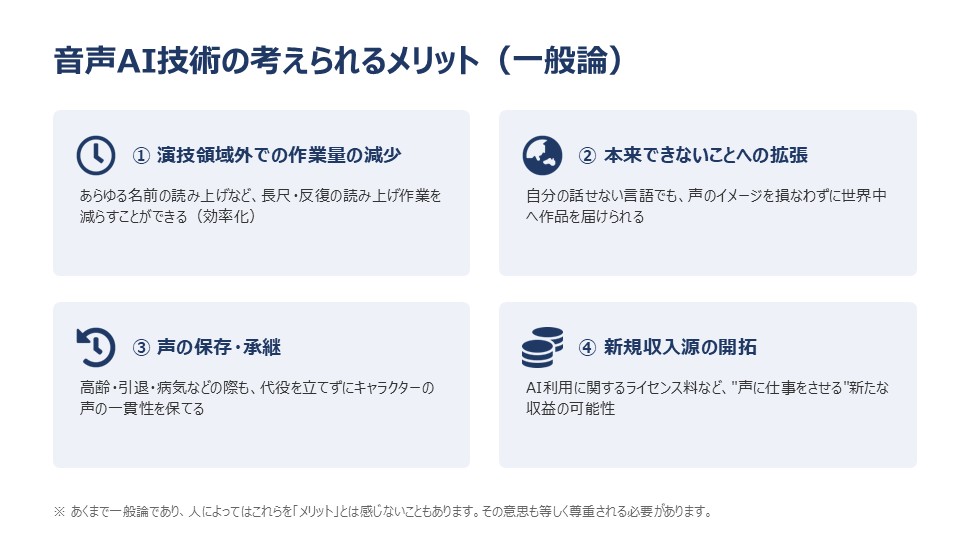
However, it's important to note that some people may not perceive these as beneficial at all.
For example, some voice actors, in the event of an unforeseen circumstance that prevents them from voicing a character, would prefer to pass the character's voice on to a successor rather than using AI-generated voices to maintain the character's voice, thereby fostering the growth of new voice actors. Others are concerned that creating a localized version using AI-generated voices of their own voices could, conversely, deprive local voice actors of opportunities to dub their work. Thus, even if there are benefits, they are not universal, and it is difficult to generalize them.
The difficulty in generalizing is also common to the disadvantages. The following table summarizes some of the commonly cited disadvantages of speech-generating AI:
① The danger of mistaking something that is not you for "you".
② Decreased opportunities for growth for new employees, etc.
③ Decrease in job opportunities
④ Impact of the widespread adoption of AI as a replacement for AI
⑤ Risk of criminal use
Some of the points that have been pointed out include:
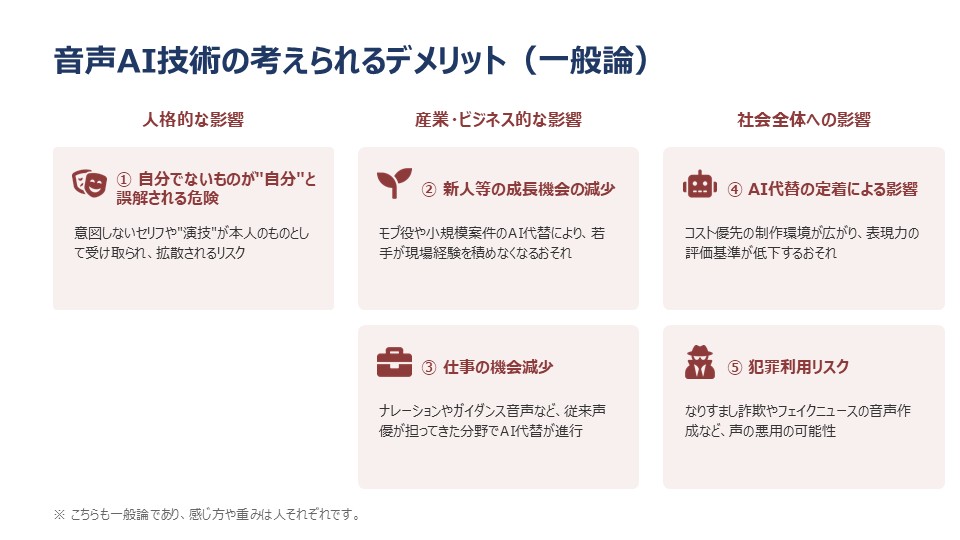
The risk of something that isn't you being mistaken for "you" is a major drawback that affects one's identity and professional beliefs. This drawback is particularly evident when voices created without the voice owner's permission are circulated without them knowing that they were created by a voice generator. It must be extremely painful for a professional actor to have "something else" that is not their own carefully crafted expression accepted as their own performance, and it is also quite unbearable to have things they didn't mean misunderstood as having been said by them.
Other relatively easy-to-understand disadvantages include a decrease in growth opportunities for newcomers, a reduction in job opportunities, and the impact of the widespread adoption of AI replacement, all of which relate to the sustainability of the voice acting profession. Until now, small-scale projects, background characters, and so-called "background voices" have been important for young voice actors to learn about the industry and to interact with senior voice actors. If these are increasingly replaced by AI-generated voices in the future, some voice actors are worried that growth opportunities will decrease and the voice acting industry will shrink. In fact, AI voices are already being used in small-scale narration projects.
In 2026, "trials" and "government considerations" began to move forward.
Having recognized these various advantages and disadvantages, voice actors"NOMORE Unauthorized AI Generation"We have consistently expressed concerns about AI models, services, and AI-generated voices created without the permission of the voice owners, based on these and other issues.
I will cover the domestic developments to date in the next installment (Part 2), but as we entered 2026, the situation regarding the protection of voices has entered a new phase.
First, in May 2026, it was revealed that voice actor Kenjiro Tsuda had filed a lawsuit against TikTok's operating company in the Tokyo District Court, demanding the removal of videos featuring narration that mimicked his voice using AI generation technology, without his permission. According to the complaint, the account in question had posted at least 188 videos since July 2024, featuring narration mimicking Tsuda's voice quality, discussing urban legends and trivia, and was generating revenue of 500,000 to 750,000 yen per month depending on the number of views. In August 2025, the court ordered the disclosure of the poster's information, but the poster could not be identified, leading to the lawsuit against the platform operating company in November of the same year.
This is believed to be the first lawsuit in Japan concerning the unauthorized use of voices generated by AI, and allegations include violations of the Unfair Competition Prevention Act and infringement of publicity rights. The operating company is reportedly arguing that the voice is a "unique male voice," but this is a highly anticipated trial with various points at stake, including whether the voice is "similar" to the AI-generated voice (however, the video in question has already been removed, so it remains to be seen how far the judgment will go).
Furthermore, in April 2026, the Ministry of Justice established a "Study Group on the Nature of Civil Liability for Unauthorized Use of Portraits, Voices, etc." comprised of experts, and held its first meeting on April 24. To date, the group has held five discussions to clarify, based on current laws and precedents, when civil liability (damages and injunctions) can be sought for the unauthorized use of portraits and voices generated by AI. And on July 28, as mentioned at the beginning..."Summary Report (Draft)"The report has been published, and the final version is expected to be compiled soon. I plan to discuss the outline of this report in more detail in "Domestic Part 2: Can Publicity Rights Protect Voices?".
Final thoughts
The issue of voice protection is often discussed, particularly in the context of generative AI, but voice AI technology itself is not "evil." The problem lies in the fact that voice AI models and services specifically tailored to a person's voice are created without their permission, or that very similar voices are distributed. The question of what legal arguments can be made against such situations is precisely the issue of "voice protection."
The issue of protecting voices has been gaining increasing attention recently and is now frequently covered in the news. However, it wasn't until various organizations and volunteer voice actors took action that this issue reached this level of prominence.
Next time, I'd like to trace the developments both in Japan and abroad in chronological order.
Profile
Kotaro Tanabe(Attorney at Mimura Komatsu Law Office)
After working at a firm that handled a wide range of legal matters including litigation, negotiations, corporate law, and intellectual property law, I now provide comprehensive support for intellectual property law, including copyright, patents, and trademarks, covering everything from domestic and international contracts and system development to litigation.
The company specializes in businesses involving characters, particularly anime, manga, games, and AI, and focuses on providing one-stop support to corporations and individuals engaged in character-based businesses. Regarding voice-generating AI and voice-related issues, the company is actively working to establish voice protection by engaging in ongoing dialogue with voice actors, voice acting agencies, voice AI providers, and industry associations.
He was involved in the creation of the "Interim Report of the Study Group on Intellectual Property Rights in the AI Era," which treated "voice protection" as a separate topic, as an assistant counselor (part-time) at the Cabinet Office's Intellectual Property Strategy Promotion Office. He also serves as an auditor for the Japan Voice AI Learning Data Authentication Service Organization.
Our firm offers comprehensive consultations on various issues surrounding AI-generated speech and "voice protection," from clarifying rights to considering specific response strategies.
Click here for information on one-time consultations and retainer agreements.
【2026.7.31】
Click here for legal advice and media appearances
ContactMiKoTama email magazine
Distributing various legal information topics via email newsletter
Other articles by Kotaro Tanabe
-
[Series: Generating AI and Voice Protection] Part 2
Tracking domestic and international developments chronologically – From private self-defense to rule-making"My favorite voice actor is singing a song they've never sung before." "In that person's voice, they're saying something they would never say themselves..."
-
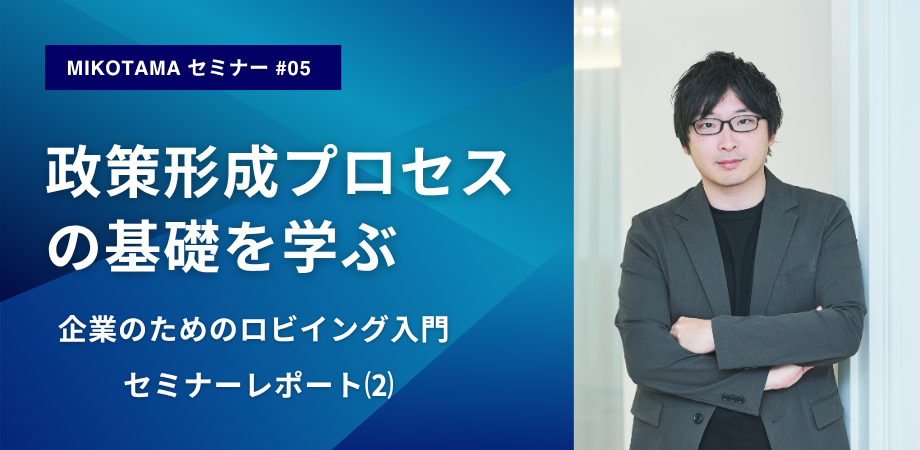
[Seminar Report] Learning the Fundamentals of the Policy-Making Process: An Introduction to Lobbying for Businesses (Part 2)On June 2025, 6, the Mikotama Seminar #20 "Policy Formation Platform" hosted by Mimura and Komatsu Law Office...
Related article
-
[Trade Secrets / Seminar Report - Part 2]
Leaking it is a disaster. Even letting it get in is a disaster. ~The reality and practical aspects of trade secret risk~MIKOTAMA Seminar #09, hosted by Mimura Komatsu Law Office, was held on September 29, 2026...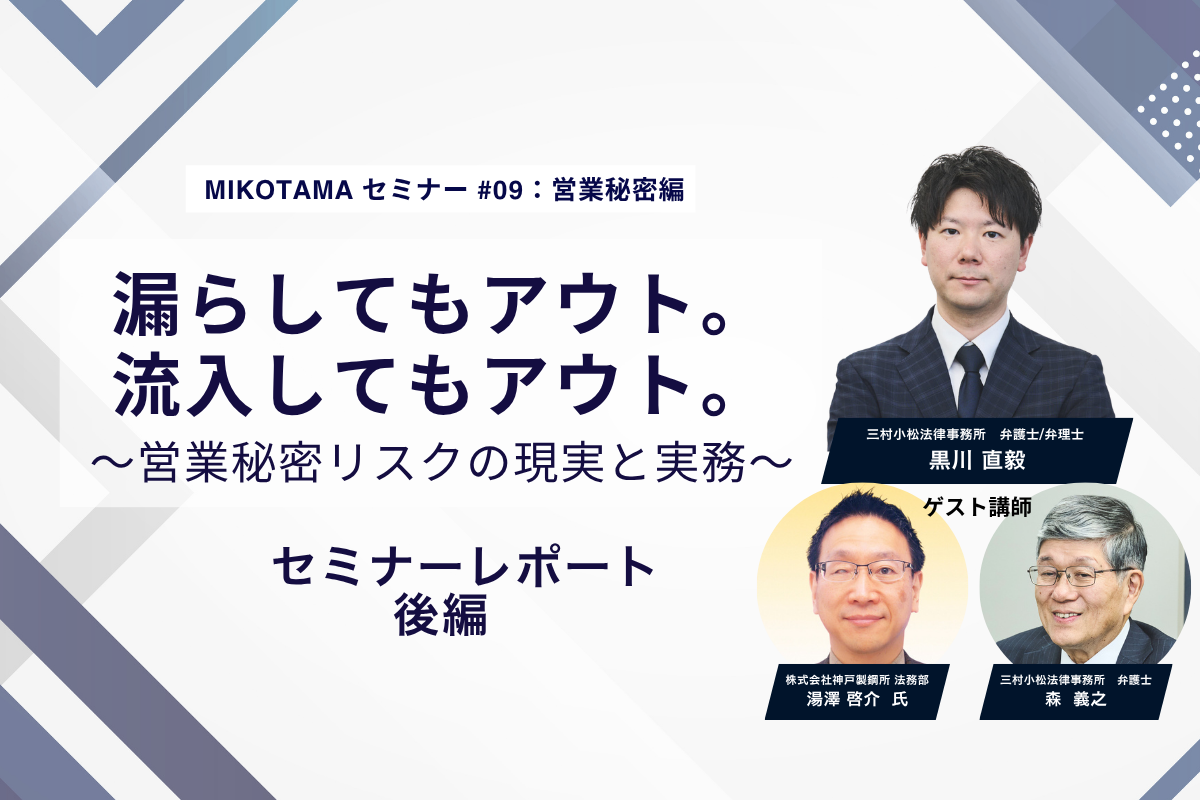
-
[Series: Generating AI and Voice Protection] Part 2
Tracking domestic and international developments chronologically – From private self-defense to rule-making"My favorite voice actor is singing a song they've never sung before." "In that person's voice, they're saying something they would never say themselves..." -
[Trade Secrets / Seminar Report - Part 2]
Leaking it is a disaster. Even letting it get in is a disaster. ~The reality and practical aspects of trade secret risk~MIKOTAMA Seminar #09, hosted by Mimura Komatsu Law Office, was held on September 29, 2026...