[Series: An Introduction to Trade Secrets for Business Professionals] Part 3
The biggest point of contention: "Secrecy management"
What's needed isn't "impenetrable defense," but "recognizability."

A trade secret, under the Unfair Competition Prevention Act, refers to information that meets the three requirements of confidentiality, usefulness, and non-publicity.
In recent years, data breaches have increased in both criminal and civil cases, with the number of arrests by the police increasing approximately eightfold and the number of consultations received increasing approximately sixfold. More than 80% of the leaks occur internally, such as through employees or former employees, and in some cases, not only the person who took the information but also the company that hired the new employee and the employees themselves have been punished.
This series, "An Introduction to Trade Secrets for Practitioners," is the introductory part (4 parts in total) of a series in which lawyer Naoki Kurokawa, who was in charge of the Ministry of Economy, Trade and Industry's "Guidelines for Trade Secret Management" revised in March 2025 and amended in 2023, explains the basics in an easy-to-understand manner.
In the third installment, we will discuss confidentiality management.
Confidentiality management refers to the management of information so that employees who access it can recognize it as confidential. It is the most contested of the three requirements for trade secrets in court. What is required is not perfect "impenetrable management" but "recognizability," and the starting point is a state where employees are aware that the information is being treated as confidential, such as through ㊙ markings or access restrictions. In addition, we will also explain the differences between non-public information and the novelty of patents.
XNUMXst:Leaking them is a crime, and receiving them is also a crime – the risk of "trade secrets" leaking is now a reality.
The second:What exactly is a "trade secret"? – Three conditions and other ways to protect them
Why is "secrecy management" a point of contention?
Trade secrets are invisible "information." While patents have their scope of rights clearly defined to a certain extent by their claims, trade secrets lack such definitions. If the scope remains ambiguous and someone later claims, "That was a trade secret," employees will be unable to determine what information they can disclose from their daily interactions, thus harming predictability.
Therefore, the law states,Companies are required to clearly indicate to employees, executives, and business partners what they wish to keep confidential, and to ensure that these parties are aware of this. This is what is meant by confidentiality management.Since we are protecting something as intangible as information, the starting point of protection is to make it clear to the other party "what is confidential and what is not."
The keyword is "recognizability".
The key point is "recognizability." To put it extremely, if you label something as "Confidential," employees will generally understand that "this information is secret and must not be shared." That's why confidentiality is more likely to be recognized in such cases.
On the other hand,No matter how important the information, if it is not managed in any way, it cannot be said to be "managed as confidential" and will not be protected..
The trade secret management guidelines indicate that it is unrealistic to expect companies to maintain "airtight" confidentiality. In other words, the question is whether efforts are being made to instill in employees a sense of responsibility, such as "this is confidential and should be treated differently from general information."
However, it is important to note that"Management that can be recognized" and "management that actually prevents leaks" are two different things.That's the point. While labeling something as "confidential" may satisfy the requirement for confidentiality management, that alone does not prevent information leaks.Measures to actually prevent leaks should be considered from a perspective separate from confidentiality management.There is a need.
Do I have to write "Top Secret"?
Marking content as confidential is a powerful method, but it's not the only one. Similarly, restricting access is also a powerful method, but it's not essential.
When the importance of the information is obvious to everyone, normative management such as restricting access using IDs and passwords to log into company computers, or prohibiting disclosure in employment regulations and confidentiality agreements, may suffice.It has been with.
It's important to note that the decision isn't made mechanically based solely on whether or not something is displayed or whether or not access is restricted.
Civil and criminal cases have the same requirements—however, the timing of their establishment differs.
The definition of trade secrets is based on the same provision in both civil and criminal law (Article 2, Paragraph 6 of the Unfair Competition Prevention Act), and its interpretation is considered to be common to both.[1]The revised guidelines in 2025 clarified this point (see Nagoya District Court judgment, March 18, 2022, Case No. 29 (wa) 427 for a similar court case).[2]there is).
However, there are certain characteristics of criminal cases that require attention. In civil cases, if an employee takes trade secrets from their company, it is not enough to simply "acquire" the information with the intent to gain personal gain or to cause damage to the company; it is only when the information is used or disclosed that it constitutes unfair competition.[3].
On the other handIn criminal law, a crime can be established at the moment of "appropriatement" with the intent to gain profit or cause harm.[4]In other words, it can become illegal even before using or disclosing it, at the stage of taking it out, or even at the stage of copying it.
When combined with the fact that "digitalization has made proof easier," which was mentioned in the first installment, we can see the background behind why the police are able to take action more easily.
[1] Criminal penalties for trade secrets were introduced in the 2003 amendment, but the article-by-article commentary at the time states: "Regarding the requirements for 'trade secrets' in civil law, they are (1) usefulness, (2) non-publicity, and (3) confidentiality management. However, the requirement of (3) confidentiality management is also interpreted strictly, and its scope can be said to be limited. Therefore, no special requirements different from those in civil law were added, and they were made the same as those in civil law" (Ministry of Economy, Trade and Industry Intellectual Property Policy Office, ed., "Article-by-Article Commentary on the Unfair Competition Prevention Act [2003 Amended Edition]" (Yuhikaku, 2003), p. 147).
[2] "In criminal proceedings, the requirements for determining whether something constitutes a trade secret should be understood to be the same as those for civil proceedings, considering the circumstances surrounding the 2003 amendment to the Unfair Competition Prevention Act."
[3] Article 2, Paragraph 1, Item 7 of the Unfair Competition Prevention Act: "When a business operator who possesses trade secrets (hereinafter referred to as a "trade secret holder") is shown such trade secrets, any act of using or disclosing such trade secrets for the purpose of obtaining an unfair profit or for the purpose of causing damage to the trade secret holder."
[4] Article 21, Paragraph 2 of the Unfair Competition Prevention Act
"2. Any person who falls under any of the following items shall be punished by imprisonment for not more than 10 years or a fine of not more than 20 million yen, or both."
1. A person who is shown a trade secret by the trade secret holder and, with the intent to obtain an unjust profit or to cause harm to the trade secret holder, violates his/her duties related to the management of the trade secret and acquires the trade secret by any of the following methods.
(Omitted)
(b) Making copies of the contents or records of trade secrets on recording media, etc., or of objects in which trade secrets are embodied.
Ha (omitted)"
So far, we've covered what a trade secret is and its three essential requirements.
In the next installment (Part 4), we will examine what happens if you infringe on trade secrets—the three risks involved: criminal penalties, civil liability, and disciplinary action.
Profile
Naoki Kurokawa(Attorney and Patent Attorney, Mimura Komatsu Law Office)
He handles a wide range of corporate legal matters, primarily focusing on intellectual property, trade secret protection, unfair competition prevention law, and economic security. He spent four years as Assistant Director of the Intellectual Property Policy Office at the Ministry of Economy, Trade and Industry, where he gained frontline experience in legislative practice, including involvement in the revision of the Unfair Competition Prevention Law and the revision of the Trade Secret Management Guidelines. His strength lies in providing sophisticated legal advice that delves into the background of legal systems and policy objectives. He is an expert who supports the protection of corporate competitiveness and business value, including intellectual property litigation, countermeasures against counterfeit products, and information leakage response.
Our firm assists companies in ensuring their information is managed in a way that meets confidentiality standards—including reviewing the consistency of regulations, labeling, access restrictions, and confidentiality agreements.
Click here for information on one-time consultations and retainer agreements.
【2026.8.31】
Click here for legal advice and media appearances
ContactMiKoTama email magazine
Distributing various legal information topics via email newsletter
Other articles by Naoki Kurokawa
-
[Series: An Introduction to Trade Secrets for Practitioners] Part 4 (Final)
What happens if you infringe on trade secrets?
- Criminal penalties, civil liability, and disciplinary actionIn serious cases, criminal penalties may be imposed. In cases of serious infringement of trade secrets, criminal penalties may be imposed. For individuals...
-
[Series: An Introduction to Trade Secrets for Business Professionals] Part 2
What exactly are "trade secrets"?
- Three conditions and other ways to protect yourselfWhat constitutes a "trade secret"? Trade secrets can be broadly divided into sales information and technical information. Sales...
-
[Series: An Introduction to Trade Secrets for Business Professionals] Part 1
Leaking it is a no-no, and receiving it is also a no-no.
—The risk of "trade secrets" being leaked is now a reality.A series of trade secret leaks: In recent years, there has been a noticeable increase in reports of trade secret leaks being treated as criminal cases...
Related article
-
[Trade Secrets / Seminar Report - Part 2]
Leaking it is a disaster. Even letting it get in is a disaster. ~The reality and practical aspects of trade secret risk~MIKOTAMA Seminar #09, hosted by Mimura Komatsu Law Office, was held on September 29, 2026...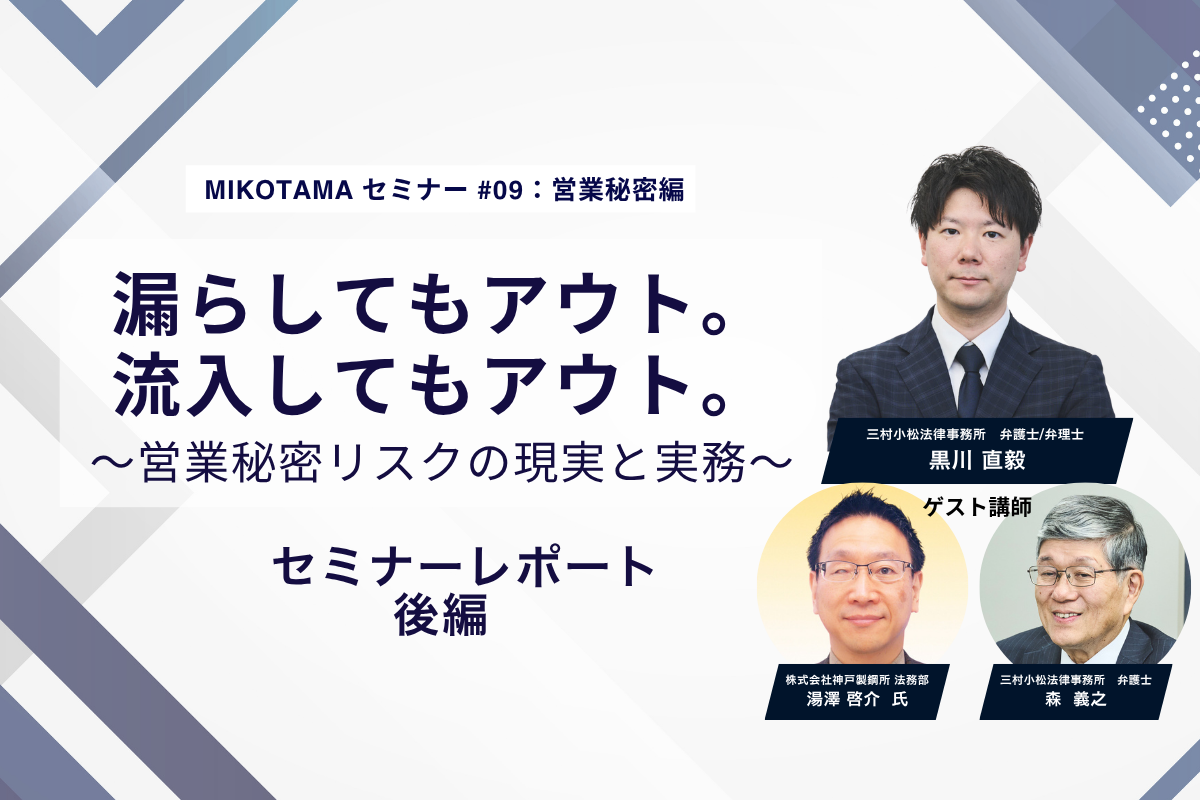
-
[Series: Generating AI and Voice Protection] Part 2
Tracking domestic and international developments chronologically – From private self-defense to rule-making"My favorite voice actor is singing a song they've never sung before." "In that person's voice, they're saying something they would never say themselves..."
-
[Trade Secrets / Seminar Report - Part 2]
Leaking it is a disaster. Even letting it get in is a disaster. ~The reality and practical aspects of trade secret risk~MIKOTAMA Seminar #09, hosted by Mimura Komatsu Law Office, was held on September 29, 2026...