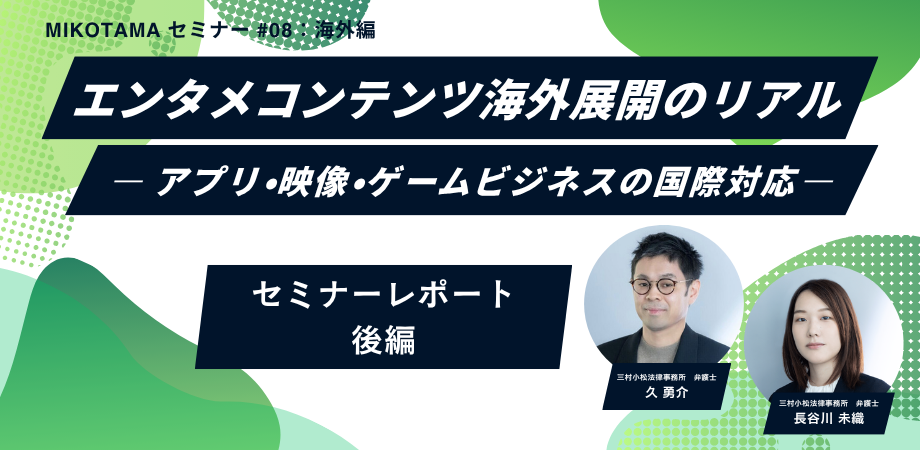
[Entertainment Report: Overseas Edition / Seminar Report Part 2]
The Realities of Overseas Expansion of Entertainment Content – International Adaptation for Apps, Videos, and Games –


When considering overseas expansion, many legal and general affairs personnel likely find themselves grappling with questions such as, "Which country's laws do we need to comply with?" and "What will happen if we violate local regulations?"
In the entertainment content sector in particular, multiple legal risks, including privacy, protection of minors, copyright, and trademarks, are intricately intertwined. Even if a display or service design is common in Japan, it may be subject to regulations overseas or lead to problems with local authorities, platforms, and users.
At the MIKOTAMA Seminar #08, "The Realities of Overseas Expansion of Entertainment Content - International Response for App, Video, and Game Businesses," held on April 21, 2026, and hosted by Mimura Komatsu Law Office, lawyers Yusuke Hisa and Mio Hasegawa, who are experts in overseas expansion strategies, explained the main regulations and practical responses when expanding digital content overseas.
This article, based on the seminar content, will introduce practical considerations common to overseas expansion of apps, games, and video content, as well as key points when utilizing overseas law firms.
Click here for the first part
Key challenges common to overseas content expansion: localization, licensing design, and brand control.
① Issues with localization (subtitles and dubbing)
When expanding overseas, localization such as subtitles and dubbing is crucial to deliver the work to local users.
In particular, when expanding into Asian countries where English is not widely spoken, the production of subtitles and dubbing materials in local languages greatly influences the reach of the content. In English-speaking countries, it is often sufficient to prepare one version with English subtitles and dubbing, but in Asian countries where there is a high demand for individual support in multiple languages such as Thai, Vietnamese, and Indonesian, it is necessary to produce materials for each country. Therefore, it is important to clarify at the contract stage who will prepare the subtitles and dubbing materials and how.
There are two main approaches to producing subtitles and dubbed versions of a film.
(1) When outsourcing production to a local licensee
If an agreement is reached where the production of subtitles and dubbing materials is entrusted to a local licensing partner, and the Japanese side does not bear the production costs, there is an advantage in that production costs can be reduced. However, a problem that often arises is quality control. Not all countries have the same mature anime and video culture as Japan, so there may be cases where the voice actors' performances or the tone of the translation do not meet the standards expected by the Japanese side. In addition, there is the problem that the Japanese side may not be able to fully control how the nuances are translated into the local language.
Furthermore, aside from quality control, the handling of materials after the contract ends is another point that often becomes an issue. For example, if the licensing agreement is switched from company A to company B, the question of whether company B can use the subtitles and dubbing materials produced by company A becomes a practical issue.
Therefore, if you are commissioning production to a local licensee, it is a good idea to include the following three points in the contract.
- Can the Japanese side supervise the translation content and voice actor casting, and do they have the final say?
- Handling of materials after contract termination (return, deletion, suspension of use, etc.)
- Can the Japanese rights holder of the video work reuse it for another company?
If you try to negotiate these things later, your bargaining power will decrease once the material has already been distributed. In licensing agreements that involve localization, it is crucial to include conditions that take future use into consideration when signing the contract.
(2) When produced in Japan and loaned to the local area
When the Japanese rights holder produces the subtitles and dubbing materials, quality control becomes easier. However, the production costs are often borne by the Japanese side, and negotiations may be necessary if the licensor is to bear part of the costs. In addition, depending on the target language, there are practical challenges in securing a company in Japan that can undertake the production of subtitles and dubbing.
Which approach is appropriate depends on the importance of localizing the target content, the power dynamics with the licensor, and the budget. In any case, proceeding with a contract without making this decision is likely to lead to problems later on.
② Design of license period and scope
Decide what to do after the event ends from the beginning.
One aspect often overlooked in licensing agreements is "what happens after the license period ends." Content is a long-term asset for a company, and even after a licensing agreement with a particular party ends, it needs to be utilized for future developments. Therefore, it is important to design the contract from the outset with the end-of-term handling in mind.
For example, if a license has been granted for the manufacture and sale of character goods or other products, inventory may remain in the local area upon termination of the contract. It is advisable to specify in advance in the contract the details of what will happen after termination, such as whether to dispose of the inventory, whether to allow continued sales for a certain period, and how to settle royalties if continued sales are permitted.
Specify not only the "region" but also the "language" and "platform".
In the case of digital content, simply limiting the licensed region may not be sufficiently effective. For example, even if a region-specific license is granted, such as "Country A only," depending on how it is written, it could be interpreted as "distribution from within Country A to global platforms such as YouTube is also possible." Without restrictions on accessible regions, language, or platform, if a licensee in Country A uploads English-language content to a global platform, it can easily be viewed from outside Country A. If an exclusive license is then later granted to Country B, a problem arises where the exclusive license in Country B cannot be established due to its relationship with Country A's use of the content.
Therefore, in digital content licensing agreements, it is fundamental to specifically define the scope of the license not only in terms of region, but also in terms of language and distribution platform.
③ Brand control (securing opportunities for supervision)
Advertising and promotion are also crucial elements in local expansion. Depending on the content, it is ideal to include a condition that advertising materials such as posters, cutouts for social media posts, and materials provided to influencers be produced and published only after prior supervision by the rights holder in Japan.
Leaving everything to the local team can lead to inconsistent release timings and the product being marketed in a way that doesn't align with the Japanese side's intentions. Therefore, it's crucial to clarify in advance what kind of advertising materials can be produced and used locally, and at what stage the Japanese side can review them.
Furthermore, when lending advertising materials or video data to a local site, it is sometimes necessary to clearly define who has access to them and to include risk management for information leaks and data breaches in the contract.
An entertainment lawyer explains how to manage fees at overseas law firms.
Three key points for smart expense management
(1) Craft your questions before making a request.
If you vaguely request a survey of local laws with a phrase like, "Just tell me about them for now," you might receive a nearly 10-page memo listing only the relevant regulations. This often results in significant expenses without a clear understanding of what you actually need to do.
Before engaging an overseas law firm, it's advisable to first clarify potential risks associated with your company's services with your Japanese legal counsel. By focusing your inquiries on specific questions, you can avoid unnecessarily broad investigations and potentially reduce overall costs.
(2) How to handle situations where the estimate is exceeded
In overseas projects, the actual billed amount can sometimes significantly exceed the initial estimate. It's not uncommon for it to be two or three times higher. However, even in such cases, many firms will agree to a "light off" (reduction) if requested.
If you go through a Japanese legal counseling firm, the negotiations can be handled between lawyers, significantly reducing your mental burden. It's important to get into the habit of checking with the firm first when an overestimate occurs, rather than silently paying it.
(3) Europe will prioritize based on risk tolerance.
When expanding into Europe, complying with only the EU's GDPR and the UK's GDPR is relatively easy. However, if you try to cover the different consumer laws of each country (such as cooling-off regulations and cancellation regulations), the research costs alone can reach several million to nearly 1,000 million yen. Therefore, if Europe is not your main market, it is more practical to prioritize the scope of compliance based on the importance of the business and the magnitude of the potential risks.
However, if your service includes elements that are subject to particularly strict regulations, such as protection for minors, adult content, or social interaction features, you need to be more careful. This is a point that should be kept in mind regardless of the country or region.
Always conduct a naming and trademark search *before* launching.
In practice, what is often overlooked is how service names and work titles are perceived overseas, and conducting prior trademark research.
It's not uncommon for Japanese words to take on inappropriate meanings in English-speaking countries when transliterated directly into Roman letters. Furthermore, in Chinese-speaking regions, local media sometimes use their own kanji transliterations for English or Japanese names. Therefore, it's crucial to check with local native speakers and partners about how the name will be perceived before releasing a service.
Regarding trademarks, it is essential to conduct a search before launching a service. If, after a service is established, it is discovered that the name has already been registered by another company, the costs of changing the service name or negotiating for a license will be significantly higher than the costs of the preliminary search. In China in particular, due to the issue of fraudulent applications, early filing before starting marketing and regular monitoring thereafter are especially important.
Seminar Q&A
Points that are often confusing in advertising production and contract negotiations: Up to this point, we have summarized the practical points that are common to overseas expansion, such as localization, design of license period and scope, brand control, utilization of overseas law firms, naming and trademark research, etc.
During the Q&A session in the latter half of the seminar, questions were raised on topics that often cause confusion in overseas expansion, such as how to deal with actors' unions in global advertising and how to handle the Japanese-style "separate consultation" clause, which frequently becomes a problem in contract negotiations with overseas companies. Below are some excerpts from the Q&A related to the themes of the second half.
Compliance with SAG-AFTRA in global advertising
Q: What are the points to keep in mind when responding to SAG-AFTRA?
A: There are many situations where we have to comply with the templates and regulations set by the actors' union, which can make things difficult. However, some companies choose to use artists who are not members of the actors' union, so being flexible and adapting to each project is one possible approach.
In actual cases, there have been instances where advertisers have specified that performers who are not union members be selected for advertisements used globally. While unions are supposed to protect actors, in reality, avoiding unions has become a practical option, which is a troubling situation.
Treatment of "to be discussed separately" clauses in overseas contracts
Q: In Japan, it's common business practice to say, "Let's decide on the details as we go along," but what about overseas?
A: In English-language contracts, especially those based on US or European standards, it is common practice to include all business terms and conditions in the contract clauses. The phrase "to be discussed separately," which is often seen in Japanese contracts, is rarely used in English-language contracts.
In license agreements, if details such as the scope of the license, how revenue will be shared, and how expenses will be included are not clearly specified in the contract, there is a risk that the other party may interpret the contract in a way that is advantageous to them. When concluding license agreements or commercialization agreements with overseas companies, we strongly recommend that you consult with a lawyer to carefully review the contents of the contract.
To avoid situations where the other party misinterprets the terms and conditions in a way that suits them, resulting in the loss of potential profits in unexpected ways, clearly and specifically defining business terms in the contract is a fundamental approach when entering into contracts overseas.
Speakers/panelist:
Yusuke Hisashi
After studying abroad at Cardozo School of Law in the US, worked at a US law firm.
Our services primarily focus on supporting Japanese companies entering the US market, negotiating content licensing agreements, and providing support for overseas expansion strategies.
Currently, he focuses on supporting the overseas expansion of games and video content, and also provides legal advice on the areas of regulation surrounding digital content, such as the protection of underage users and privacy laws. His strength is practical support that takes into account the differences in the legal systems between Japan and the United States.
Mio Hasegawa
He served as in-house counsel for the company operating the video streaming platform "Hulu," handling a wide range of contractual matters, including content licensing agreements and production contracts, as well as regulatory compliance related to the app business. Currently, he provides legal advice, including contracts, rights management, and regulatory compliance, primarily in the digital content field such as video and music, for international content businesses.
Please feel free to contact us before you have any concerns.
If you have concerns such as "I want to check if my app/game is legally compliant overseas," "I want to revise my terms of service and privacy policy for overseas expansion," or "I want a lawyer to review my content licensing agreement," please consult with a lawyer at Mimura Komatsu Law Office.
Mimura Komatsu Law Office has lawyers with extensive experience in overseas expansion of entertainment/digital content fields such as apps, games, videos, and music. We provide legal support tailored to the practicalities of the content business, from negotiating contracts in English with overseas business partners, to developing business schemes, clarifying contract terms, and handling disputes.
For requests and inquiries, please contact us.CLICK HERE
【2026.7.24】
Click here for legal advice and media appearances
ContactMiKoTama email magazine
Distributing various legal information topics via email newsletter
Related article
-
[Series: Generating AI and Voice Protection] Part 2
Tracking domestic and international developments chronologically – From private self-defense to rule-making"My favorite voice actor is singing a song they've never sung before." "In that person's voice, they're saying something they would never say themselves..."
-
[Series: An Introduction to Trade Secrets for Practitioners] Part 4 (Final)
What happens if you infringe on trade secrets?
- Criminal penalties, civil liability, and disciplinary actionIn serious cases, criminal penalties may be imposed. In cases of serious infringement of trade secrets, criminal penalties may be imposed. For individuals...
-
[Series: An Introduction to Trade Secrets for Business Professionals] Part 3
The biggest point of contention: "Secrecy management"
What's needed isn't "impenetrable defense," but "recognizability."Why is "confidentiality management" a point of contention? Trade secrets are intangible "information." In the case of patents, ...