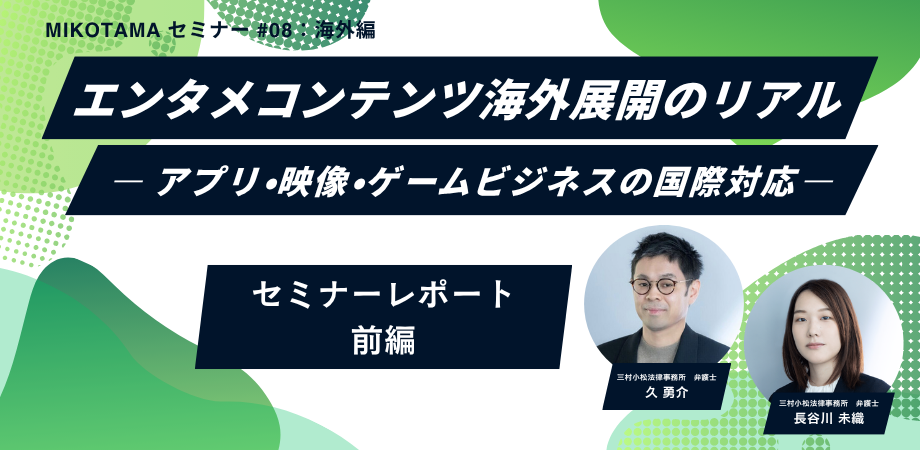
[Entertainment Report: Overseas Edition / Seminar Report Part 1]
The Realities of Overseas Expansion of Entertainment Content – International Adaptation for Apps, Videos, and Games –


When considering overseas expansion, many legal and general affairs personnel likely find themselves grappling with questions such as, "Which country's laws do we need to comply with?" and "What will happen if we violate local regulations?"
In the entertainment content sector in particular, multiple legal risks, including privacy, protection of minors, copyright, and trademarks, are intricately intertwined. Even if a display or service design is common in Japan, it may be subject to regulations overseas or lead to problems with local authorities, platforms, and users.
At the MIKOTAMA Seminar #08, "The Realities of Overseas Expansion of Entertainment Content - International Response for App, Video, and Game Businesses," held on April 21, 2026, and hosted by Mimura Komatsu Law Office, lawyers Yusuke Hisa and Mio Hasegawa, who are experts in overseas expansion strategies, explained the main regulations and practical responses when expanding digital content overseas.
Based on the content of the seminar, this article summarizes the regulations in major markets such as the United States, South Korea, China, and Taiwan, as well as practical points that entertainment companies should keep in mind when expanding overseas.
Key checkpoints when expanding into the US: COPPA, CCPA, accessibility, and gacha regulations.
When launching an app or game in the United States, you need to check four points in advance: ① protection of children's personal information (COPPA), ② California Privacy Act (CCPA/CPRA), ③ accessibility compliance, and ④ regulations on gacha (loot boxes).
① COPPA (Children's Online Privacy Protection Act)
COPPA (Children's Online Privacy Protection Act)This is a U.S. federal law that requires prior notification to and consent from parents before collecting, using, or disclosing personal information from children under the age of 13 online. Violations can result in penalties of up to approximately $5 per offense.
The Federal Trade Commission (FTC) has published guidance on how to obtain consent, and in practice, many services use the "Email Plus/Text Plus" method. This method can only be used if the personal information collected from children is not disclosed to third parties and is used only by the company. The procedure is as follows:
- Send an email or SMS to the parent/guardian.
- Obtain consent from parents/guardians.
- A confirmation email will be resent after a certain period of time, providing an opportunity to withdraw consent.
While some apps may ask users to enter their date of birth for age verification at the beginning, the collection of this date of birth itself is not considered a violation of COPPA according to the FTC's FAQ.
While the number of COPPA enforcement cases is not particularly high, a key characteristic is the extremely large penalties imposed. For example, in the case of Epic Games, a settlement was reached for a payment of $275 million for a violation. There are also several other cases where settlements range from $20 million to $25 million.
Regulations concerning the protection of minors are becoming stricter in countries including the United States and Europe. When developing apps or games for children, or that children may use, it is advisable to consider COPPA compliance from the early stages of service design.
【Reference】FTC: Children's Online Privacy Protection Rule: A Six-Step Compliance Plan for Your Business
[Frequently Asked Questions 1]Is it okay to obtain your email address for the purpose of handling inquiries?
Even services that collect little to no personal information, such as casual games, may sometimes require email addresses for customer support. Collecting email addresses without parental consent is permitted if all of the following conditions are met:
- After the issue is resolved, the email address will be deleted.
- We will respond to only one specific question from a user, and only once.
- Do not use that email address for any purpose other than inquiries.
[Frequently Asked Questions 2]Is parental consent required just to obtain an IP address?
IP addresses are also included in personal information as defined by COPPA.
However, parental consent is not required if the device is used solely for supporting internal operations, and in practice, many apps and games operate based on this interpretation.
② CCPA/CPRA (California Privacy Act)
CCPA (California Consumer Privacy Act)This is California's personal data protection law. It was later amended by the CPRA (California Privacy Rights Act), expanding the obligations of businesses and the rights of consumers regarding the handling of personal data. While it is widely known in Japan, it's crucial to first confirm whether your company falls under its scope of application.
There are several requirements, but one guideline for eligibility is whether the total annual sales for the previous calendar year were $25 million or more (currently $26,625,000 or more, adjusted for inflation). The sales referred to here are not "sales in California," but the total sales worldwide, including Japan and Europe. However, even if the sales criteria are not met, the CCPA may apply if the company handles a certain amount of personal information of California residents or households, or if it derives a certain percentage or more of revenue from the sale or sharing of personal information.
One area of particular interest under the CCPA is the regulation of "selling and sharing personal information with third parties." The requirements for user consent when selling or sharing personal information with third parties are as follows:
- Under 13 years old: Parental consent (opt-in) is required.
- Ages 13-16: Active consent (opt-in) from the user.
- For users 16 years and older: Sharing can be stopped (opt-out) if the user requests not to share.
Regarding opt-out options, it is legally required to include a "Do not sell or share my personal information" link within the website or app, and additional methods such as email, phone, or postal mail must also be provided.
Major platform operators such as Apple and Google have established Data Transfer Agreements (DPAs) that meet the requirements of the CCPA for contractors (contractors) that do not constitute "third-party sharing." Checking the DPAs of businesses with which you share personal information makes it easier to organize your own company's compliance status.
③ Accessibility (ADA Act/CVAA Act)
Accessibility refers to the obligation to ensure that people with disabilities can receive the same level of service as able-bodied individuals.
In the United States, discrimination against people with disabilities is prohibited.ADA (Americans with Disabilities Act)While this forms the basis for accessibility measures, there is ongoing debate in court cases regarding the extent to which the ADA Act applies to online services that do not have physical stores.
However, regarding games,CVAA Act (Twenty-First Century Communications and Video Accessibility Act)This has made it clear that accessibility measures are required for some communication functions, such as the in-game chat function.
- If voice chat is available, then a text conversion (subtitles/text-to-speech) function is necessary.
- If text chat is available → Text-to-speech functionality is required.
Please note that this does not require support for the entire game, but is limited to the parts that have chat and social interaction functions.
④ Regulation of loot boxes (gacha)
Regarding gacha (loot boxes), there is active discussion about regulating them in the United States and other countries around the world.
In the United States, the question of whether gacha (loot boxes) constitute "gambling" is a point of contention. While the criteria for determining gambling vary by state law, it is generally considered gambling when the following three elements are present.
- Consideration: Some form of economic contribution is made, such as purchasing in-game currency.
- Chance (luck): The result is determined by chance (randomness), not by skill.
- Prizes: Items of real-world value that can be obtained.
When implementing gacha systems in the US market, the standard practice is to limit the items obtainable to those usable only within the game and to clearly state in the terms of service that they cannot be exchanged for real currency, transferred, or sold, thereby ensuring that they do not fall under the "prize" requirements.
【Reference】Genshin Impact - FTC Lawsuit Case
In January 2025, the FTC announced a settlement with the company that operates the popular game "Genshin Impact," which included a payment of $20 million.
The issue at hand was,
① The collection of personal information of users under the age of 13 without parental consent (violation of COPPA).
② A "dark pattern" (violation of the FTC Act) where rare items are advertised as having a "high probability of appearing," but in reality the probability is extremely low.
Those are the two points.
The settlement terms include "requiring parental permission for users under 16 to use loot boxes" and "disclosure of gacha drop rates."
The regulations surrounding gacha games vary greatly from country to country and region to region. It is important to check the local regulatory trends individually.
- Belgium: Strict regulations on paid loot boxes.
- Netherlands: Depending on the potential for cash conversion and game design, it could pose a problem under gambling regulations.
- Brazil: Laws will be amended in March 2026. Use will be prohibited for those under 18.
- Australia: Category 15 years and older if it includes paid loot boxes.
- European PEGI Standards: Paid random items are generally categorized as being for ages 16 and over.
Key Points for Expanding into Asia — Regulations and Trademark Strategies in South Korea, China, and Taiwan
When expanding into Asia, it is important to pay attention to South Korea's rating requirements under its so-called Movie & Video Act, measures against fraudulent trademark applications in China, and future legal developments in Taiwan.
Furthermore, since the definition of "minor" age differs from country to country, the terms of service and display methods must be designed to suit each country rather than simply applying the same specifications used in Japan.
South Korea: Ratings for video content and games
In South Korea, the "Act on the Promotion of Film and Video (Film and Video Act)" mandates the rating (age classification) of video content. This applies not only to theatrical films but also to packaged products such as DVDs, online streaming content, and even short dramas, which have been rapidly increasing in recent years.
The review process is, in principle, conducted by the Video Rating Committee for each video content, and is categorized as All Ages, 12 years and older, 15 years and older, etc.19 years old and aboveThe content is categorized into these grades. Major platforms, due to the enormous number of content they handle, sometimes adopt a system where they are certified as "proprietary grading service providers" and conduct their own internal reviews. On the other hand, when licensing video content from Japan, it is more practical to handle the necessary grading through the licensing party or local partners.
Around the end of 2024, the South Korean authorities suddenly intensified their crackdown, and there were cases where businesses that had previously been distributing content without undergoing review were suddenly reprimanded. Even with laws that already existed, stricter enforcement can suddenly force compliance, so it is necessary to always stay informed of the latest situation. In particular, compliance with regulations overseas requires judgment based on local operations and practices, so it is advisable to consult with experts who can cooperate with local stakeholders as early as possible.
In South Korea, all games, including PC games, smartphone games, and online games, are required to obtain a rating.
South Korea: In-app currency and protection of minors
In South Korea, there is an obligation to guarantee users who purchase in-app currency the right to cancel the purchase within 7 days of purchase.
In Japan, there is no legal obligation to implement a cooling-off period for mail-order sales, including online transactions. Therefore, designing the billing process with the same approach as for services targeting the Japanese market may result in non-compliance with local laws and platform requirements.
Furthermore, the age at which a person is considered a minor varies from country to country (Japan: under 18, South Korea: under 19, Thailand: under 20). Therefore, it is necessary to check the rules for each country regarding whether minors can cancel contracts, age verification and parental consent, and the scope of billing restrictions.
Thus, the methods for selling in-app currency and the design of features related to protecting minors need to be reviewed on a country-by-country basis.
China: Measures against trademark misappropriation and copyright registration system
One of the problems many Japanese companies face when developing content in China is the issue of "unauthorized trademark applications." Unauthorized trademark applications occur when a third party who does not have the rights files for and registers a trademark before the company has done so, and this happens frequently in the entertainment content sector as well.
Possible solutions include the following:
- File trademark applications as early as possible before starting marketing in China.
- For content that requires a focus on specific areas, consider filing a patent application not only for the title of the work, but also for the names of the main characters, the logo, and important icons and motifs within the work.
- Since there is a possibility of fraudulent applications being filed in product/service categories different from those for which our company has filed/registered, we monitor this regularly.
If you discover that an application has been filed fraudulently, you can file an objection within three months of publication. Furthermore, if the registered patent has not been used for three consecutive years without a valid reason, you can consider requesting cancellation due to non-use.
In recent years, China has been increasingly adopting standards for trademark decisions, partly due to its efforts to attract global business. Therefore, with the right procedures in place, it is quite possible to take effective action against fraudulent applications.
Furthermore, China has a "copyright registration system." Similar to Japan, copyright arises at the time of creation, but in China, obtaining a registration certificate makes it easier to prove infringement when filing objections to unauthorized applications or when requesting the removal of infringing content from various platforms.
Taiwan: Attention on future developments in OTT service regulations.
In Taiwan, legislation for the "Internet Viewing Management Act" (also known as the Netflix Act or OTT Act) is currently under consideration.
The bill has been debated on issues such as business registration, regulation of certain behaviors, appropriate content rating, and user protection. However, at present, the system design and coordination among stakeholders are still ongoing, and the specific content of obligations and those to whom they apply will need to be monitored in the future legislative developments.
In the second part, we will introduce common points to be aware of in various countries when expanding overseas, and how to utilize overseas law firms.
Speakers/panelist:
Yusuke Hisashi
After studying abroad at Cardozo School of Law in the US, worked at a US law firm.
Our services primarily focus on supporting Japanese companies entering the US market, negotiating content licensing agreements, and providing support for overseas expansion strategies.
Currently, he focuses on supporting the overseas expansion of games and video content, and also provides legal advice on the areas of regulation surrounding digital content, such as the protection of underage users and privacy laws. His strength is practical support that takes into account the differences in the legal systems between Japan and the United States.
Mio Hasegawa
He served as in-house counsel for the company operating the video streaming platform "Hulu," handling a wide range of contractual matters, including content licensing agreements and production contracts, as well as regulatory compliance related to the app business. Currently, he provides legal advice, including contracts, rights management, and regulatory compliance, primarily in the digital content field such as video and music, for international content businesses.
Please feel free to contact us before you have any concerns.
If you have concerns such as "I want to check if my app/game is legally compliant overseas," "I want to revise my terms of service and privacy policy for overseas expansion," or "I want a lawyer to review my content licensing agreement," please consult with a lawyer at Mimura Komatsu Law Office.
Mimura Komatsu Law Office has lawyers with extensive experience in overseas expansion of entertainment/digital content fields such as apps, games, videos, and music. We provide legal support tailored to the practicalities of the content business, from negotiating contracts in English with overseas business partners, to developing business schemes, clarifying contract terms, and handling disputes.
For requests and inquiries, please contact us.CLICK HERE
【2026.6.19】
Click here for legal advice and media appearances
ContactMiKoTama email magazine
Distributing various legal information topics via email newsletter
Related article
-
[Series: Generating AI and Voice Protection] Part 2
Tracking domestic and international developments chronologically – From private self-defense to rule-making"My favorite voice actor is singing a song they've never sung before." "In that person's voice, they're saying something they would never say themselves..."
-
[Series: An Introduction to Trade Secrets for Practitioners] Part 4 (Final)
What happens if you infringe on trade secrets?
- Criminal penalties, civil liability, and disciplinary actionIn serious cases, criminal penalties may be imposed. In cases of serious infringement of trade secrets, criminal penalties may be imposed. For individuals...
-
[Series: An Introduction to Trade Secrets for Business Professionals] Part 3
The biggest point of contention: "Secrecy management"
What's needed isn't "impenetrable defense," but "recognizability."Why is "confidentiality management" a point of contention? Trade secrets are intangible "information." In the case of patents, ...