[Fashion Law / Seminar Report]
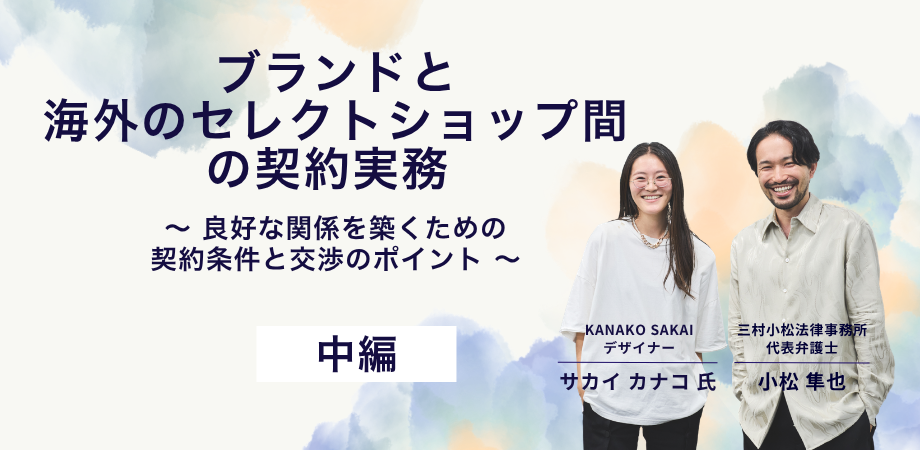
Contract Practices Between Brands and Overseas Select Shops: Contract Terms and Negotiation Points for Building Good Relationships (Part 2)
On April 13, 2026, the Mikotama Seminar #07-2, "Contract Practices Between Fashion Brands and Overseas Select Shops: Contract Terms and Negotiation Points for Building Good Relationships," was held, hosted by Mimura Komatsu Law Office. The seminar featured a fashion brand designer and COO as guests, and, based on actual trouble cases, explained the necessity of contract negotiation and specific points to consider.
Speakers/panelist:
Kanako Sakai(Fashion brand "KANAKO SAKAI"designer)
The brand debuted with its Spring/Summer 2022 collection and won the JFW Next Brand Award the following year, 2023.
I met lawyer Komatsu while studying in New York, and I have been receiving continuous legal support from him since the brand's inception.
Takashi Ishikawa(COO of Kanako Sakai)
Responsible for production management and overall brand operations for the brand.
KOMATSU Junya(Representative Attorney, Mimura Komatsu Law Office)
She has worked on cases in various fields, including corporate law, intellectual property, and litigation, and in 2015 she majored in fashion law at Fordham University School of Law in New York.
After returning to Japan, he has handled legal matters in creative fields such as fashion, art, architecture, and design, and currently supports more than 200 apparel companies.
When fashion brands expand overseas, many legal and administrative staff face the challenge of "contracts with overseas select shops." Many of these problems—such as "I can't understand the English contract," "I don't know which clauses are risky," or "I don't know what I can negotiate"—can actually be solved by consulting with a lawyer specializing in the fashion industry.
This article, based on the seminar content, focuses on contractual details in transactions with select shops, outlining potential problems and how to avoid them.
Click here for the first part
Payment terms and measures to mitigate the risk of non-payment.
Payment terms with overseas select shops – the importance of setting a deposit.
In recent years, there has been an increase in bankruptcies and unpaid wages cases involving overseas select shops and department stores, and the number of consultations has reached record highs.
The payment terms typically presented in contracts from the other party are "within 60 days of receiving the invoice," but this is a high-risk condition for the brand. Debt collection overseas is costly and time-consuming, and the situation is very different from collection within Japan.
The following are practical points to consider when arranging payment terms:
- Setting a deposit (advance payment)
We first try to request 50% when we receive an order. Often, this ends up being 30% after negotiation, but we want to secure at least 30%. - Timing of receiving the remaining balance
Ideally, I'd like to receive the full amount before shipment. - Clear statement of conditions for release
The order should clearly state that the brand reserves the right to cancel the order if the deposit is not received within 30 days of the order being placed (otherwise, there is a risk of inventory being left unsold). - Setting of late payment penalty clause
Clearly state the late payment penalties (e.g., 18% per annum, 1.5% per month) in case of delayed payment.
Cancellation clause in case of non-payment of deposit
It is important to include a termination clause in the contract in case the deposit is not paid by the due date. If nothing is written, there is a risk of being stuck with unusable inventory without being able to terminate the contract. Conversely, if you cancel without notice and sell the inventory elsewhere, you may be sued for damages by the other party.
A recommended clause would be: "If the deposit is not received within 30 days of the order date, the brand may terminate the contract."
Setting of late payment penalty clause
It is recommended to include a late payment penalty clause in the contract as a penalty for delayed payments. As a guideline, you could suggest around 1.5% per month (18% per year) in overseas contracts. In Japan, it is common to omit such a clause in the contract due to the feeling that it would be rude to ask for payment in case of late payments, but without it, the risk of payments being delayed increases. It can also be used as leverage in negotiations if non-payment continues, such as saying, "I will waive the late payment penalty if you pay first."
This clause has rarely been rejected during negotiations.
Utilizing order sheets
Drafting and signing contracts often takes time, and it's not uncommon for them to be finalized after the transaction has already begun. As a practical solution to such situations, we recommend "including contract terms on the order sheet."
This method involves listing important details as "special notes" at the bottom of the order sheet, instead of creating a formal contract that includes all clauses. The contract becomes valid once the person in charge signs it and exchanges emails with the other party.
The minimum requirements that should be included in the order sheet are as follows:
- Payment terms (deposit rate, timing of remaining balance payment)
- Cancellation conditions in case of non-payment of deposit
- Late payment penalties
- Matters concerning trademark registration (such as prohibition of registration by select shops)
- Governing Law and Jurisdiction
Compared to formal contracts, the procedure is simpler, it feels less awkward for select shops, and it is especially suitable for initial transactions with new business partners. Mimura Komatsu Law Office has provided support and assistance with the creation of such order sheets many times in the past.
Concepts of Governing Law and Jurisdiction Clauses
In the event of a dispute, which country's laws and courts should be applied?
It is also important to have clauses that specify which country's laws will apply (governing law) and which country or region will conduct the trial (jurisdiction) in the event of a dispute. If the purpose is to collect payment, designating the "court in the defendant's place of residence" is the most practical method from a cost-effectiveness perspective.
Contracts must always specify "which country's laws will govern the resolution (governing law)" and "where the trial will take place (jurisdiction)." While AI and some lawyers may suggest arbitration in Singapore or a third country, international arbitration can be very expensive in terms of legal fees alone, making it unsuitable for recovering small amounts of money.
As a Japanese brand, you might naturally want to rely on Japanese law and courts, but in practice, this isn't always advantageous. For example, in disputes aimed at collecting payments, even if you win a judgment in Japan, there are cases where you cannot enforce it against the overseas party. In the case of China, there are also legal issues where Japanese judgments cannot be enforced.
In addition, some contracts stipulate "arbitration in a third country" (such as Singapore or Paris), but international arbitration is extremely expensive, with legal fees often exceeding 1000 million yen, making it unsuitable for recovering amounts of several million yen.
A practical option is to set the jurisdiction to the "defendant's place of residence." This method has the advantage that if the brand files a lawsuit to collect payment, they can use the courts of the other country, making enforcement smoother, and conversely, if they are sued, they can be dealt with in Japan. It is a balanced condition for both parties.
Regarding applicable law, if the purpose is payment collection, local law generally poses no significant risk, and in contracts with select shops, local law is often practically advantageous. However, caution may be necessary when contracting with certain countries. We recommend consulting with a specialist.
Final thoughts
This seminar systematically organizes the key points to consider when doing business with overseas select shops. We will summarize essential points that legal and general affairs personnel can implement starting today.
Things to prepare before trading
- Register the brand name as a trademark in Japan and China as soon as possible.
- Choose a brand name that is easy to register in the countries where you plan to expand (consulting before deciding on a brand name is the most cost-effective approach).
Things to keep in mind when reviewing and negotiating a contract
- The exclusivity clause should be limited in scope and duration as much as possible.
- We will negotiate to have our own e-commerce site excluded from the monopoly.
- It will be clearly stated that the select shop will not be allowed to acquire the trademark.
Settling the payment terms
- We recommend starting negotiations on a 50% deposit (securing at least 30%).
- The goal is to receive the remaining balance before shipment.
- Be sure to clearly state the clauses regarding late payment penalties and termination conditions.
- The order sheet includes the main requirements, and is exchanged with signatures.
These are things that can significantly reduce costs and risks by "preparing things in advance before problems arise" rather than "dealing with them after they occur." Consulting a fashion law firm specializing in fashion early on is ultimately the most cost-effective option. Transactions with overseas select shops are an important step in a brand's global expansion. On the other hand, proceeding without fully understanding the contract terms carries the risk of irreparable losses later on.
The important thing is not to act after a problem arises, but to consult with a specialist lawyer before the transaction begins and to ensure that the appropriate conditions are in place. Also, while there is a tendency to think that "negotiating is rude," in international transactions, negotiation is considered a natural process, and appropriately requesting changes to the terms can help maintain a good relationship between both parties in the long term.
In our next report, we will share details of the Q&A session that took place during the latter half of the seminar.
We hope this article will be helpful to brand managers aiming for overseas expansion in their contractual practices.
Please feel free to contact us before you have any concerns.
"I need someone to review the contract, but I'm worried about the cost." "We're about to start doing business with a new select shop, but I don't know where to begin." If you have any of these concerns, please contact Mimura Komatsu Law Office first.
In many cases, a clear direction can be determined within about 30 minutes during a preliminary consultation, and the estimated fee varies depending on the lawyer's years of experience. Compared to dealing with a problem after it has occurred, early consultation can significantly reduce both time and costs.Attorney Komatsu's InstagramWe also accept initial consultations via direct message. Please feel free to contact us before anything happens.
For requests and inquiries, please contact us.CLICK HERE
【2026.5.22】
Click here for legal advice and media appearances
ContactMiKoTama email magazine
Distributing various legal information topics via email newsletter
Other articles by Junya Komatsu
-
[Third Office Information Session Report ①]
A law firm specializing in litigation, with five former judges on staff.Mimura Komatsu Law Office was established in 2019 by attorneys Ryoichi Mimura and Shunya Komatsu.
-
[Fashion Law / Seminar Report]
Contract Practices Between Brands and Overseas Select Shops: Contract Terms and Negotiation Points for Building Good Relationships (Part 2)On April 13, 2026, Mikotama Seminar #07-2 "Fat..." hosted by Mimura Komatsu Law Office
-
[Fashion Law / Seminar Report]
Contract Practices Between Brands and Overseas Select Shops: Contract Terms and Negotiation Points for Building Good Relationships (Part 1)On April 13, 2026, Mikotama Seminar #07-2 "Fat..." hosted by Mimura Komatsu Law Office
Related article
-
[Series: Generating AI and Voice Protection] Part 2
Tracking domestic and international developments chronologically – From private self-defense to rule-making"My favorite voice actor is singing a song they've never sung before." "In that person's voice, they're saying something they would never say themselves..."
-
[Series: An Introduction to Trade Secrets for Practitioners] Part 4 (Final)
What happens if you infringe on trade secrets?
- Criminal penalties, civil liability, and disciplinary actionIn serious cases, criminal penalties may be imposed. In cases of serious infringement of trade secrets, criminal penalties may be imposed. For individuals...
-
[Series: An Introduction to Trade Secrets for Business Professionals] Part 3
The biggest point of contention: "Secrecy management"
What's needed isn't "impenetrable defense," but "recognizability."Why is "confidentiality management" a point of contention? Trade secrets are intangible "information." In the case of patents, ...